On the Common of many towns in New Hampshire there stands a recognizable structure. It is round or hexagonal or octagonal; it is elevated above ground, reached by several steps; it is roofed but is open to the air on all sides; there is a railing around the edge. What is it? It is a Band Stand. Or is it a Gazebo??
This yard feature, seen at people’s gardens, has been around for 1000s of years. The nature-loving ancient Egyptians 5000 years ago built small, roofed structures in their gardens. Covered with vines, they were designed for sitting in the shade and looking out over water. It was such a nice idea that the Persians and Greeks built them too. The Persians loved to entertain in their garden-houses, even ratifying peace treaties and negotiations in those spots. The Greeks built small, roofed structures of marble near temples for holding religious rituals or just socializing. The trend went East, and turned into locations for the tea ceremony in Japanese gardens. These buildings had various names in their local languages.
In the 1300s, the French popularized little structures outdoors, and eventually the English followed suit. From the early 1800s, English gardens were fanciful recreations of the untamed side of nature: twisting paths through the woods lead to a spot where there was a view. And there you would find a small shelter for sitting and gazing. Some say this is the origin of the word ‘gazebo,’ a word that came into vogue then.
In the early 1800s, the Industrial Revolution turned large market towns into big factory cities filled with slums and poverty. Social Reformers looked for ways to cut down on crime by giving people some wholesome entertainment, and band concerts were the answer. Churches and social clubs formed bands, and since they needed a place to play, bandstands were built. When the city of Manchester, NH was planned, there were many parks [or ‘squares’] and each contained a bandstand. After the Civil War, returning soldiers formed ‘Cornet Bands’ in many towns.
The late 1800s and early 1900s were the heyday of the small town band, of which the Temple Town Band is the oldest example. Towns hurried to build bandstands for their own local bands, and for touring musicians to give concerts. In Bennington, a bandstand was built on the grassy common in front of the Congregational Church in 1895. There was a town celebration for the dedication of this new civic structure. Around that same time, electricity came to town, in the form of street lights. The peak of the bandstand’s roof took the place of a pole for one span of electrical wires.
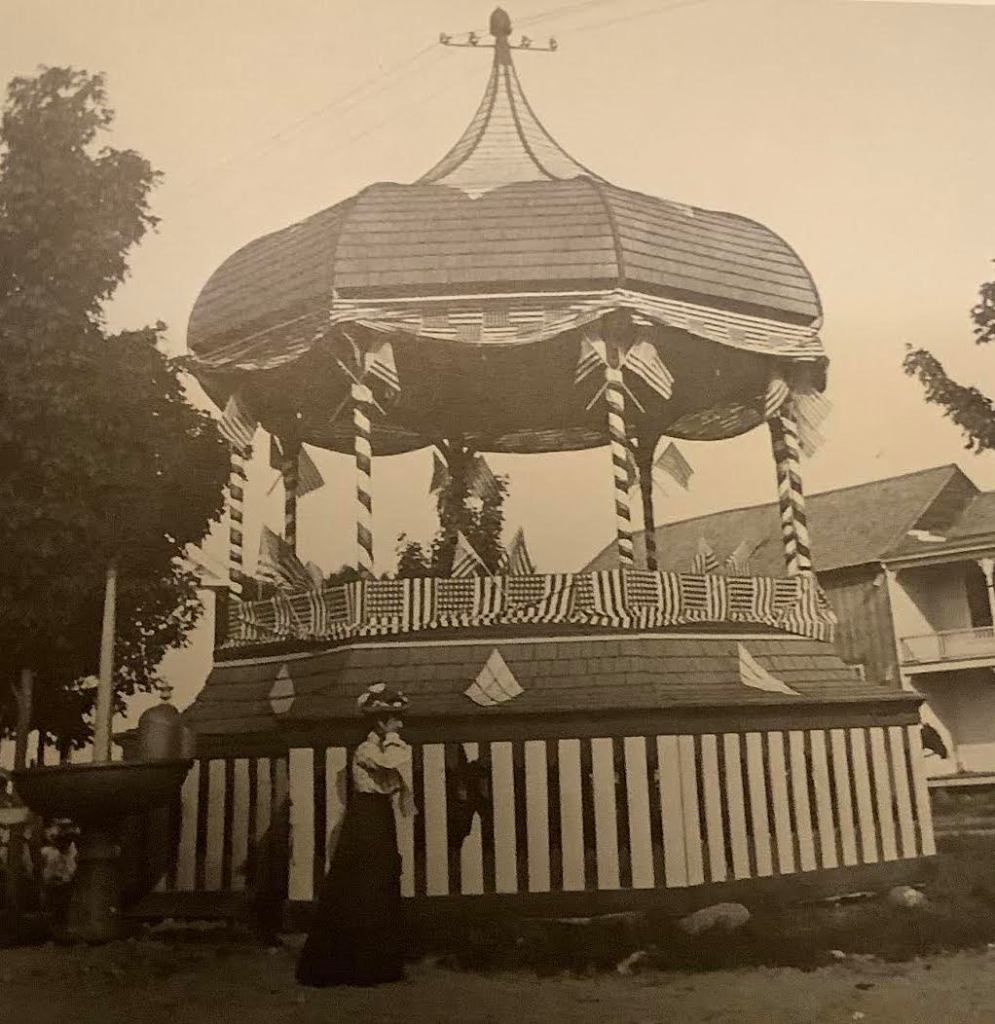
In 1949, the decision was made to move the Civil War Monument from the middle of the Main Street-Francestown Road intersection to a spot closer to the Church. To make room for it, the unused, slightly derelict old bandstand was torn down. It had long been the dream of Historical Society founder David Glynn to rebuild the Bandstand, sometimes called the Gazebo. In 2020, money provided by a bequest from Mr. Glynn, made a new bandstand/gazebo possible, but not in the same old location. Land across from the Dodge Library, at the intersection of Main Street and Greenfield Road, was purchased jointly by the Historical Society, the Library, and the Congregational Church.
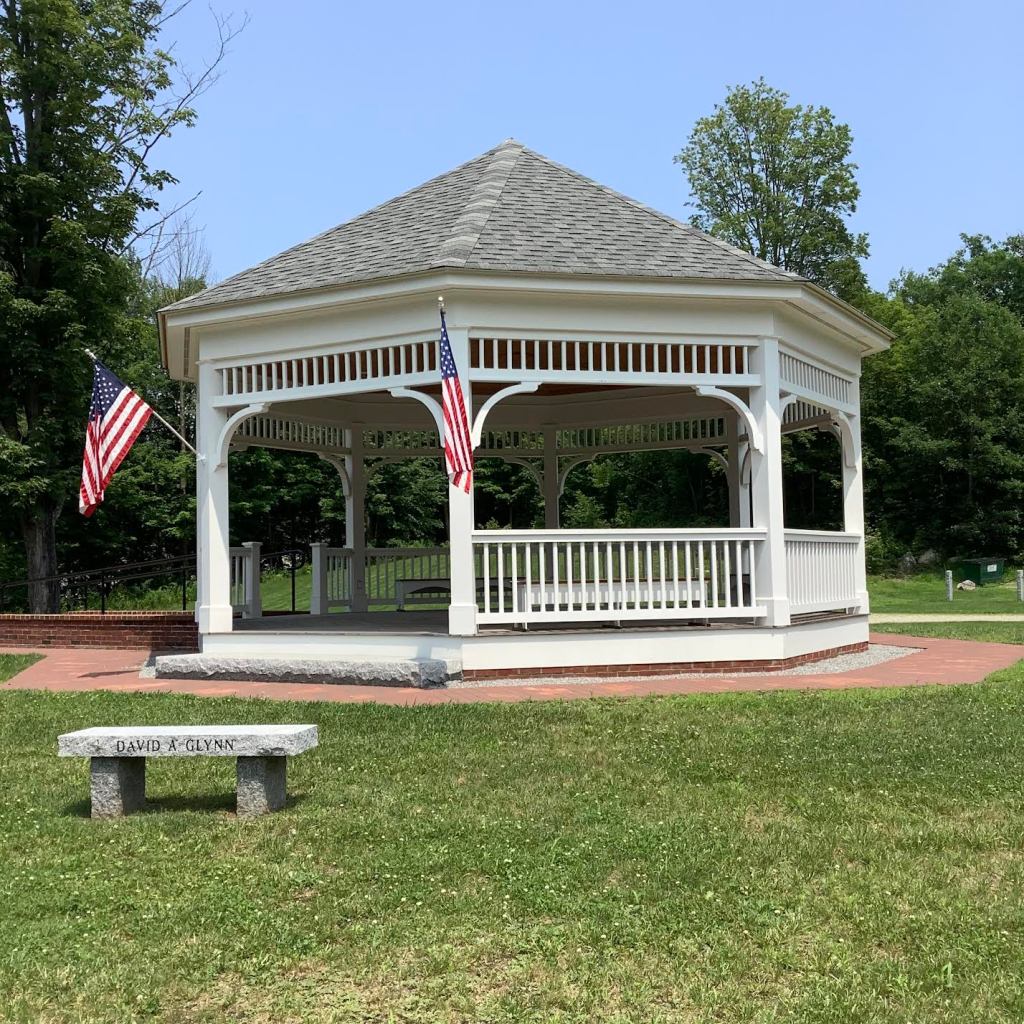
Is it a bandstand or is it a gazebo? Think of it this way: ‘gazebo’ describes a particular type of structure, and if you put musicians in it, it becomes a ‘bandstand.’
 Bennington, New Hampshire HistorySite Title