As winter days grow longer, the trees know that Spring is coming, and the sap starts to rise. When colonizing settlers first arrived in New England, they had never heard of maple syrup. The Abenaki People had invented the process of turning maple sap into maple syrup generations ago, and they taught the new-comers the process. Sugar from the Caribbean was an expensive commodity in New Hampshire, so settlers took to making their own sugar from maple sap.
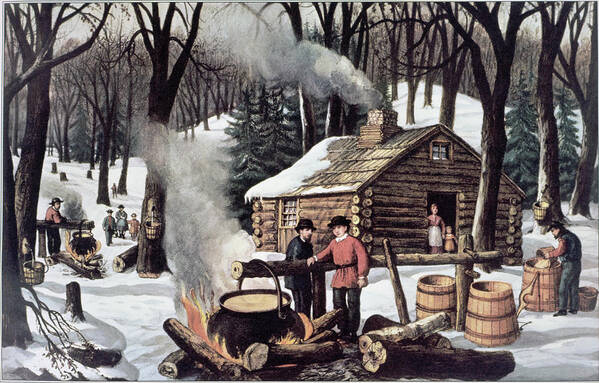
In the early 1800s, farmers and townspeople alike would plant sugar maples close to the house to make the process easier. Look for a row of old maples alongside a country road, or arranged around a Colonial or Federal-style house — those were put there on purpose by a canny long-dead resident to have a convenient source of maple sap. Otherwise the home-owner would have to range through the forest to find enough trees to tap. During the Civil War, this became an act of Northern solidarity, since the sugar made from sugar cane was produced with slave labor.
To make syrup, 40 gallons of sap — preferably from Sugar Maples, Acer saccharum — are boiled down to yield one gallon of syrup. To supply a family’s needs took a lot of sap and a lot of firewood. If the boiling is continued past the syrup point, the sugar will begin to crystalize, and come out of the solution. “First run” sap produces a light-colored, mildly-flavored syrup and sugar, compared to the syrup that the tree produces weeks later, and thus the early run was more highly prized. Sap season lasts around four weeks.
Maple syrup was used as a sweetener in baking, and of course to put on griddle cakes and bread. Maple sugar was used as a sweetener in beverages, and for dusting over a cake for decoration. Many farms that took in summer visitors would sell maple sugar candy or syrup to their guests. Those products were also useful for barter.
The next installment of the Bennington NH Historical Society Blog will be posted on March 25, 2025. If you click the Subscribe button, all future posts will be sent straight to your inbox every month – for free.
 Bennington, New Hampshire HistorySite Title