My cousin from the West Coast was visiting one Autumn, and we went for a walk on a dirt road in the woods. At a fork in the road, I mentioned that if we went that way, we could see a fine cellar hole. He asked, “What’s a cellar hole and why do they call it that?”
When people in Bennington built their first houses, it was often a log ‘lean-to’ with a dirt floor — rough accommodations to shelter you while you built a bigger house. That might be followed by a Cape-style house with a wooden floor. But early houses lacked cold storage space, so a hole was dug under the house — often after it was built — where food could be stored for the winter. Barrels of potatoes/apples/hard cider; boxes of sand containing carrots; casks of sauerkraut. These were ‘cellar holes’: a hole under the house that was the cellar. The space was reached by a trap door in the floor, with a ladder to descend when you went to fetch something.
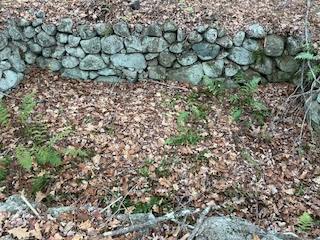
Sometimes today you look at a cellar hole and think “was the house really that small?” No, it wasn’t. An after-construction cellar might be only 10×10 feet in size, while the house would have been at least twice as large. Modern houses have cellars that have the same footprint as the house, but not back then. A fancier house might indeed have a cellar that was the size of the house, so that the sills of the house sat on a stone foundation, which also formed the walls of a commodious cellar. If the builder really planned well, there might be a stairway leading to the cellar from the outside. Very fancy, indeed.
The hole was lined with stones to form the walls, and these days that might be all that is left to tell us that once there was a house there, with a family in it, tending the land, and storing their food in the cellar. Maybe the house burned down, and the family moved away. Maybe the children all settled elsewhere, so the old homestead fell into ruin once the parents died. Maybe someone moved the actual house to another location, leaving the cellar hole behind. Cellar holes hold lots of the history of Bennington, but they aren’t saying much.
NOTE: There is a law in New Hampshire about removing stones from a stone wall [including cellar holes] on private property. So if you come across a cellar hole that looks abandoned in the woods, and think you might want some of those stones for your landscaping project, think again. The land is surely someone’s private property, and taking stones is against the law.
The next installment of the Bennington NH Historical Society Blog will be posted in December, 2027. If you click the Subscribe button, all future posts will be sent straight to your inbox every month – for free.

