Every town needs a Town Hall — where administrative work is carried out, perhaps where voting is held. Bennington, NH was incorporated in 1842, but the town lacked the appropriate civic structure until 1881. In the earliest days of Bennington, meetings were held in taverns, in private homes, or in a church. The largest and only church in town in 1843 was the Baptist Church, and that is where the first Town Meeting was held on January 13.
As the town increased in population and prosperity, the idea was proposed at Town Meeting to build a real Town Hall. It was put to a vote in 1844, ’49, ’50, ’54, ’56, and ’57 — but each time it was tabled or voted down. ‘Seems that becoming their own town was more expensive than people had thought it would be. After building bridges and roads and buying land for Sunnyside Cemetery, taxes went up and interest in new infrastructure went down.
The Civil War incurred more expenses for Bennington, so the project was put off. By the late 1860s, citizens began to be chagrined by their lack of a Town Hall. At the 1870 Town Meeting, only 35 of the 135 registered voters [all of them men] turned up for the discussions. Twenty-six of them voted ‘aye’ to set up a committee to look into building a Hall. The following July, a vote was held to see if the voters would approve $1,500. It passed, but was soon and often challenged. Finally, in March of 1871, the matter was decided: the people wanted a Town Hall, and they would pay to have it built.
A location at the East end of the main bridge near the center of the Village was chosen as the site. By September, the splendid building in the Italianate Style was open for business. It had cost $3,800. Part was paid by the town, part was paid by School Districts #1 and #2. More about that later…..
The next installment of the Bennington NH Historical Society Blog will be posted on February 16, 2026. If you click the Subscribe button, all future posts will be sent straight to your inbox every month – for free.
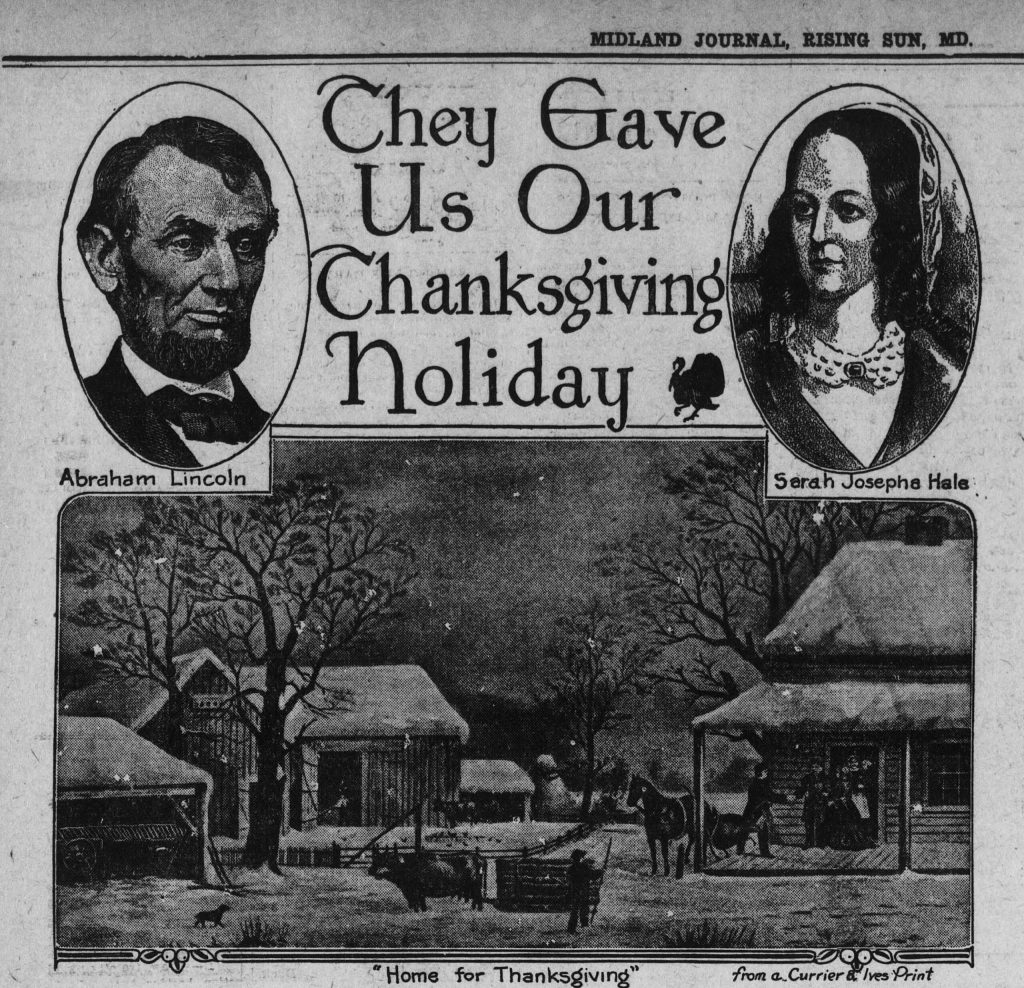
Did you know that the American Thanksgiving was ‘created’ by a New Hampshire woman? You might have been taught that it was first celebrated in Plymouth, Massachusetts — Pilgrims and Indians and all that. But that was a one-off observance of an English tradition. The true American Thanksgiving is from New Hampshire.
Sarah Josepha Buell Hale, born in Newport, was a style-maven of the 1800s. She was the editor of the popular Godey’s Ladies’ Book, published in Boston. Hale balanced work demands with raising a family as a single mother — a ‘modern’ woman if ever there was one! She was an influencer with millions of devoted ‘followers’, like the Martha Stuart of her day. In 1827, Hale wrote a novel, Northwood: Life North and South, in which she describes a ‘typical’ upper-middle class New Hampshire family celebrating a Thanksgiving meal.
Starting in 1846, Hale lobbied for a national holiday of Thanksgiving. At that time, such an event was sporadically popular in New England, but Hale thought that the entire nation should celebrate it. During the Civil War, she wrote several letters to President Lincoln urging him to declare such a holiday, in an effort toward national unity. If everyone had a holiday in common, Hale reasoned, then maybe they could agree on bigger issues too. Finally, in 1863, Lincoln decreed “A National Day of Thanksgiving and Praise”, in response to Hale’s urging. That is why the illustration at the top of this page states “They gave us our Thanksgiving Holiday”.
PS: Sarah Josepha Buell Hale also wrote “Mary Had A Little Lamb”.
The next installment of the Bennington NH Historical Society Blog will be posted on January 19, 2025. If you click the Subscribe button, all future posts will be sent straight to your inbox every month – for free.
An historian asks, “What happened on a particular day – a battle? The death of a king?” The social historian asks, “What did people do on that day – what did they wear? What did they eat?”
Today we will answer the question, “What did people drink in Bennington?” We know that people were living within the boundaries of the present town as early as 1782, so we will take that as a starting place. My references for this foray into the past include: Tea With Jane Austin; the two Town histories and Colonial Spirits.
As we saw last month, there were many non-alcoholic beverages available to early residents. Do not think that our early residents were teetotalers: alcoholic beverages were part of daily life. The Farm Wife had to be well-versed in turning plant matter into beverages: for family consumption, to supply to hired hands, to serve to guests, to preserve the harvest, and for medicinal use.
>>Gruet is an ancient fermented mixture made from herbs and grains but no hops. It is a light, refreshing alcoholic beverage with a short storage life. It would be made and served at home during the summer when the flavoring herbs were ripe.
>>Beer was consumed in vast quantities all day long. This was in keeping with traditions from the Old Country. When we read today about a man of that era drinking a gallon of beer a day, it sounds shocking. But you should know that the alcohol content was very low: 1-2.5% — practically water! Beer was made at home and also at taverns and public houses. With the addition of hops, beer could keep for months.
>>Cider was a very important beverage in early times. By 1800, apple trees had become well-established and their fruit was needed to make the mildly alcoholic drink we refer to today as ‘hard cider.’ Cider is very easy to make and was put up in barrels to last the family through the year. The alcohol content was 3.5-4%. In the winter, the cider barrels would freeze – except for the alcohol portion. Teenage boys would sneak out to the shed and get schnonkered on the highly intoxicating liquid. Cider was usually of the ‘still’ variety, not the bubbly cider more popular today.
>>Apple jack is distilled cider. Distilling was a common home activity to make small quantities of medicinal alcohol necessary for preparing tinctures. Most farm wives had a distillation apparatus and they took pride in preparing liqueurs and other distilled delights. A gallon or two of apple jack would be doled out for celebrations or as medicine for its stimulating effect.
>>Wine from Europe could be purchased at great expense in port cities, but it is unlikely that even the most wealthy Bennington citizens were drinking it until the later 1800s. Local people could make do with home-made wine. So-called ‘country wines,’ they were not made from wine grapes but from local fruits. If the Good Wife sent the children out to pick wild fruit, some of it went into pies and jellies and lots of it went into wine. Wine would be served socially and also used for medicinal purposes. “Take a little wine for the stomach’s sake,” said Saint Paul to Saint Timothy.
>>And then there is rum. Made with molasses from the Triangle Trade, rum could be purchased at the tavern or even at Whittamore’s general store. Making rum oneself was not a common practice since it took ingredients in quantities not found at home. Rum was in punch, in cocktails [they go back to the 1700s], and sometimes drunk straight up. Rum was used to influence voting all over the 13 Colonies as ‘vote buyers’ would bribe people with liquor to vote early and often for their candidate.
Rum in those days was a rather nasty beverage. To temper its harsh flavor, many other ingredients were added. A typical drink of the era might have been a Cold Flip. It contained rum, molasses, salt, a raw egg, and brown ale all shaken together and topped with nutmeg. Then there was Regent’s Punch, made of tea, rum, wine, and fruits.
The next installment of the Bennington NH Historical Society Blog will be posted on November 11, 2024. If you click the Subscribe button, all future posts will be sent straight to your inbox every month – for free.
An historian asks, “What happened on a particular day – a battle? The death of a king?”
The social historian asks, “What did people do on that day – what did they wear? What did they eat?”
Today we will answer the question, “What did people drink in Bennington?” We know that people were living within the boundaries of the present town as early as 1782, so we will take that as a starting place. My references for this foray into the past include: Tea With Jane Austin; the two Town histories and Colonial Spirits.
>>“Adam’s Ale”, as water has been called, was not uncommon as a beverage. Living on the river made fresh water very accessible. The hill farms had to rely on dug wells, but the water in town was good to drink. It is popularly said that Colonial-era people drank beer because the water was unhealthy. That was true in European cities, but not in early small-town New England, until industrial pollution made the water unsafe.
>>Tea from England was expensive and had been a bone of contention during the revolutionary war, so it is unlikely that early residents of Bennington drank much tea. Tea leaves were expensive, so they would have been steeped over and over to wring all the flavor from them. The alter-natives were herbal teas from such sources as raspberry leaves or bergamot. These were considered inferior but patriotic. Herbal teas were also used as medicines. Tea also found its way into drinks that packed a bigger punch, as we will see later.
>>Coffee would have made its way into local stores by mid-1800.
>>Sumac ‘Lemonade’ was made from the red clusters found on Staghorn and Smooth Sumac in late Summer. Soaked in hot water, then strained, the tart liquid was sweetened with honey or maple syrup to make a pleasant beverage. This knowledge came from the Indigenous People of the area.
>>For the farmer or laborer toiling in the hot sun, Switchel was considered the best thirst-quencher. Made of water sweetened with molasses or honey, the most important ingredient was cider vinegar or sometimes rum. Pitchers of cool switchel were a boon to the hay-making crew.
>>In Autumn, apples would be pressed into cider. While the season lasted, cider was a delightful drink, just as it is now.
The next installment of the Bennington NH Historical Society Blog will be posted on October 14, 2024. If you click the Subscribe button, all future posts will be sent straight to your inbox every month – for free.
While we laud John Putnam as ‘the first settler in Bennington,’ there have been indigenous people here in New Hampshire since the glaciers melted 13000 years ago. At the Tenant Swamp Site near Keene, the PaleoIndians had an encampment, leaving evidence of the oldest dwelling in North America. Professor Robert Goodby, who has studied indigenous people extensively, spoke about that dig to the Historical Society in 2017. In more modern times, the Abenaki were here before the 1600s, when Europeans arrived, and they are still here today. These are the people whom the Pilgrims met when they disembarked in Massachusetts [an Algonquian word] in 1620. These are also the people who sided with the French in the ‘French and Indian War’ of the mid-1700s.
The Abenaki, called the Dawnland People due to their lands in the far East of the continent, are the indigenous people of New England and maritime Canada. There were many sub-sets to the group, but they were related in their Algonquian language and culture.
Although at odds with the powerful Iroquois, the Abenaki learned from them their agricultural practice of planting the “3 Sisters” as crops. Primarily a hunter-gatherer-fisher folk, each family within the tribe would travel a singular route throughout the year, reuniting at the sea coast or a river for fishing in the summer.
Their dwellings were constructed of saplings, covered with woven mats and bark. Extended families lived in domed “wigwams,“ easy to build from found materials. The door of a wigwam always faced East, toward the rising sun. Smaller teepee-shaped wigwams were used on hunting trips, to sleep up to three. In the winter, an oval longhouse, large enough to house more people, was lined with blankets and furs for insulation. Their villages always had a longhouse for council meetings and tribal gatherings to arrive at decisions by consensus. To avoid depleting resources, villages were moved a few times a year — inland for the winter, near a water body for fishing in the summer.
Their cuisine was based on fish as the principle source of protein, along with game. Agriculture centered on the growing of squash, corn, and beans for eating fresh and for drying. Summers were spent preparing foods for the winter.
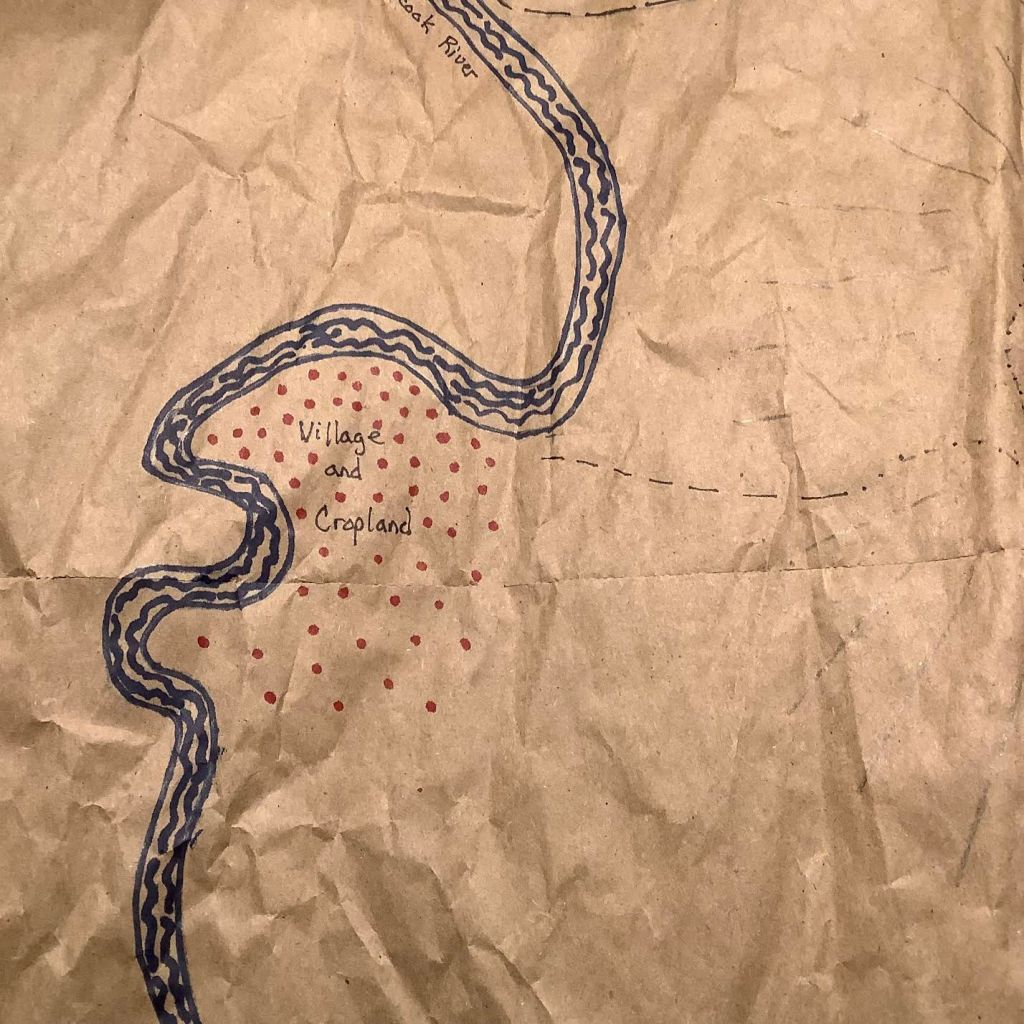
On the Right Bank of the Contoocook River, just off the Koa-wan-teg-ok Trail from Rindge to Concord, there might have been an encampment of Indigenous People.
There is anecdotal evidence that there was an Abenaki or pre-Abenaki village site in Bennington, on the banks of the Contoocook River. One can imagine the families fishing for salmon, and smoking it for future consumption. Was this a temporary encampment, used only during the salmon run? Or was it the location of a Winter village? Until the site has been studied by professionals, we will not know. Wouldn’t it be exciting to find the remains of a PaleoIndian site here?
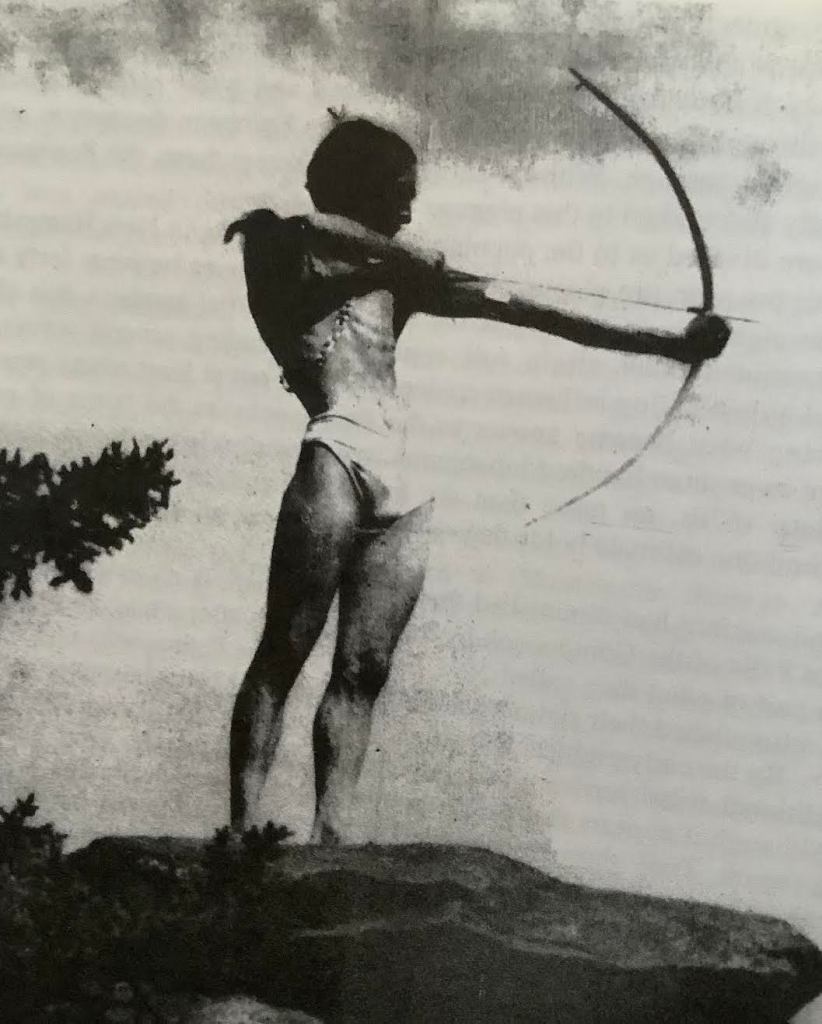
A Bennington resident named Lee Collins was an actor and model. Around 1940, he was hired for a photo shoot. The advertisement called for an image of a Native American with a bow and arrow. Did Mr. Collins have native blood? Was he the go-to model for the “Noble Savage”? In those untutored times, anybody could act as a person of another ethnic group in a film or photo, so no one would have been bothered if Mr. Collins were not an ethnic native. Local lore holds that this picture was posed at “Indian Rocks” on the old Balch Family Farm in Bennington, not far from the location seen on the map above.
Model Lee Collins, acting like an Abenaki.
The next post will be on May 29. If you click the Follow button, each monthly message will be sent straight to your inbox.
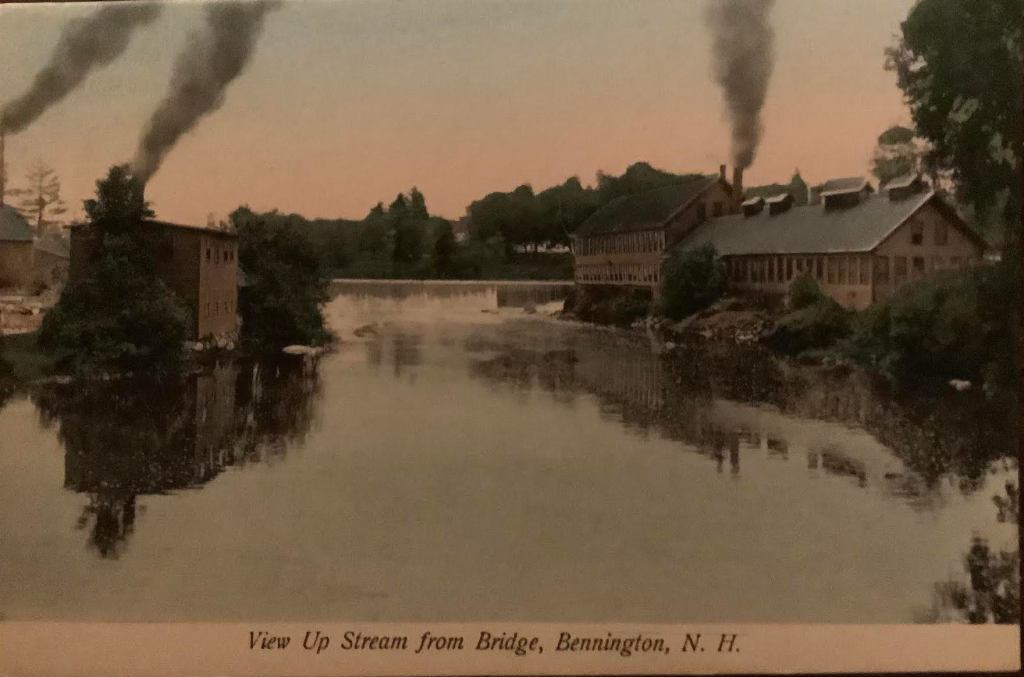
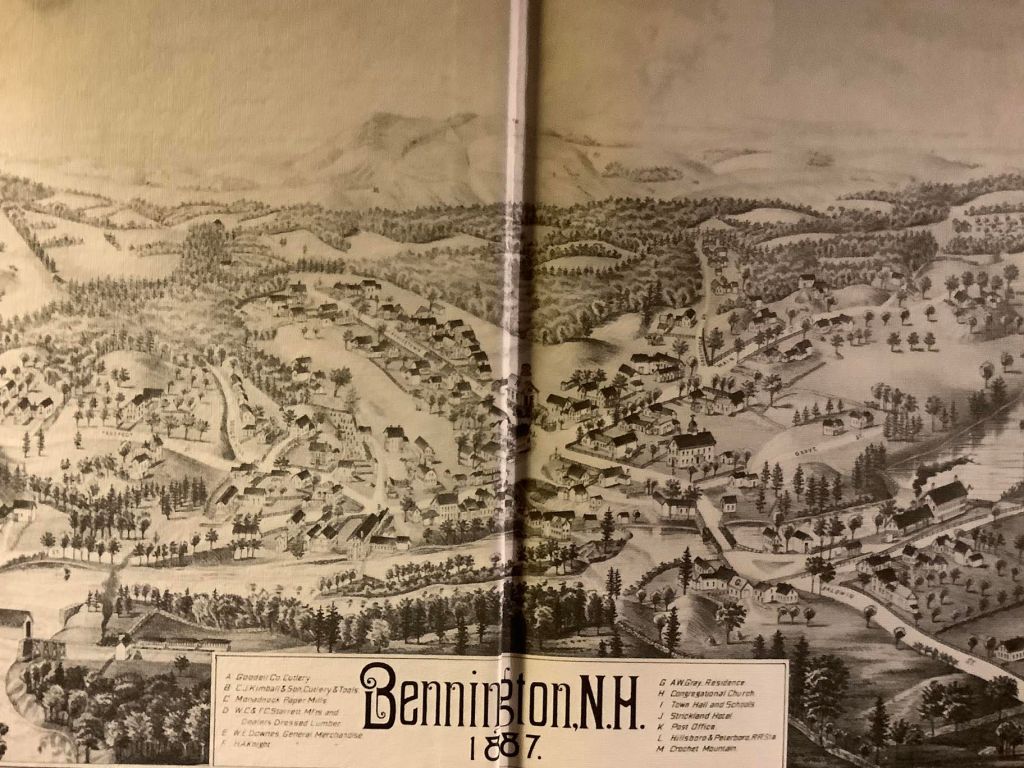
Judging from the smoke trails, one can see three active factories, viewed from the bridge over the river in the center of town. Goodell Cutlery is on the right side, just downstream of the Monadnock Dam.
Before the Town of Bennington existed, it was part of the Town of Hancock. Hancock had some running water to power some small factories, but nothing like the huge store of potential energy along the Contoocook River in Bennington. Bennington was originally planned as a site for mills.
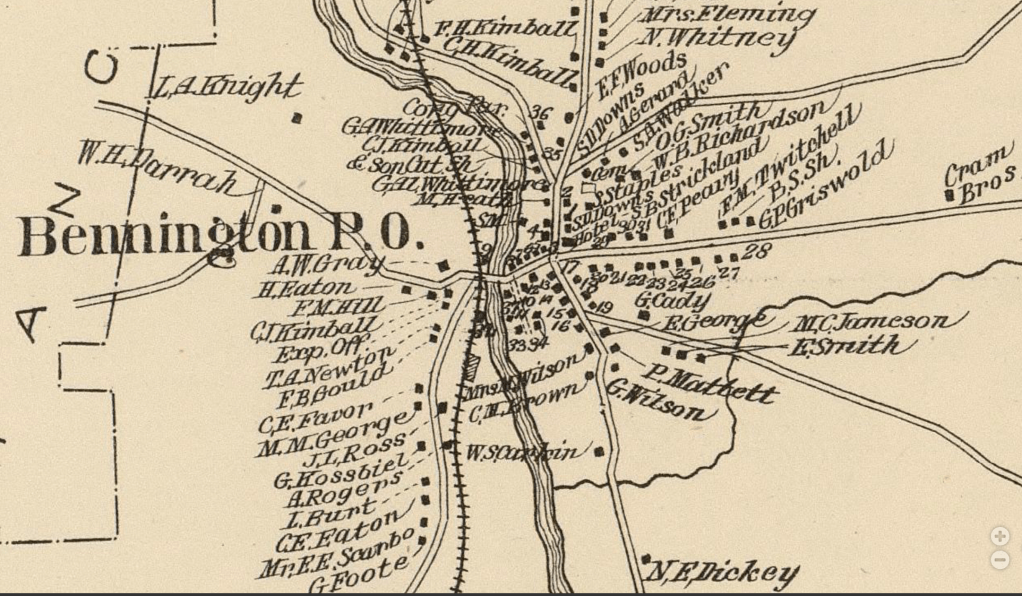
The saw mills and flour mills of the late 1700s soon gave way to fulling mills [to turn woolen fibers into felt for hats], paper mills, and knife factories in the 1820s. Because of this, Bennington was once called ‘Hancock’s Factory Village.’ On the 1859 map, not made in any great detail, a Powder Mill [gunpowder], a Paper Mill, and a Knife Factory are shown. In the 1887 map, the Goodell Cutlery Company competed with the C.J. Kimball & Son Cutlery and Tool Company. Goodell Cutlery later moved to Antrim and most people forget that they started in Bennington. Also shown were the Monadnock Paper Mill and the W.C. & F.C. Starrett lumber mill. While the factories began by using the water as their sole source of power, the smoke in the postcard picture indicates that by the late 1800s, the machinery of the mills was powered by combustion, most likely coal.
The mills attracted workers, some of whom moved from neighboring towns, some were immigrants new to this country. Workers required housing. The three white-painted Cape-Style houses on Main Street were built by Joseph Putnam around 1800, perhaps to attract workers for his mills. On the strip of land across from the Paper Mill, between the River and the road, there used to be workers’ housing in the 1880s, since replaced by the garages of the Mill. Going up Starrett Road, one sees several identical houses on the right. When you see a row of such dwellings in a mill town, you know they were built for workers and rented to them by the factory owners.
Today, the only mill that is still operating is the Monadnock Paper Mill which has been using water power to make its products since 1819.
The next installment will be posted on May 8. If you click the Follow button, all future posts will be sent straight to your inbox every month.
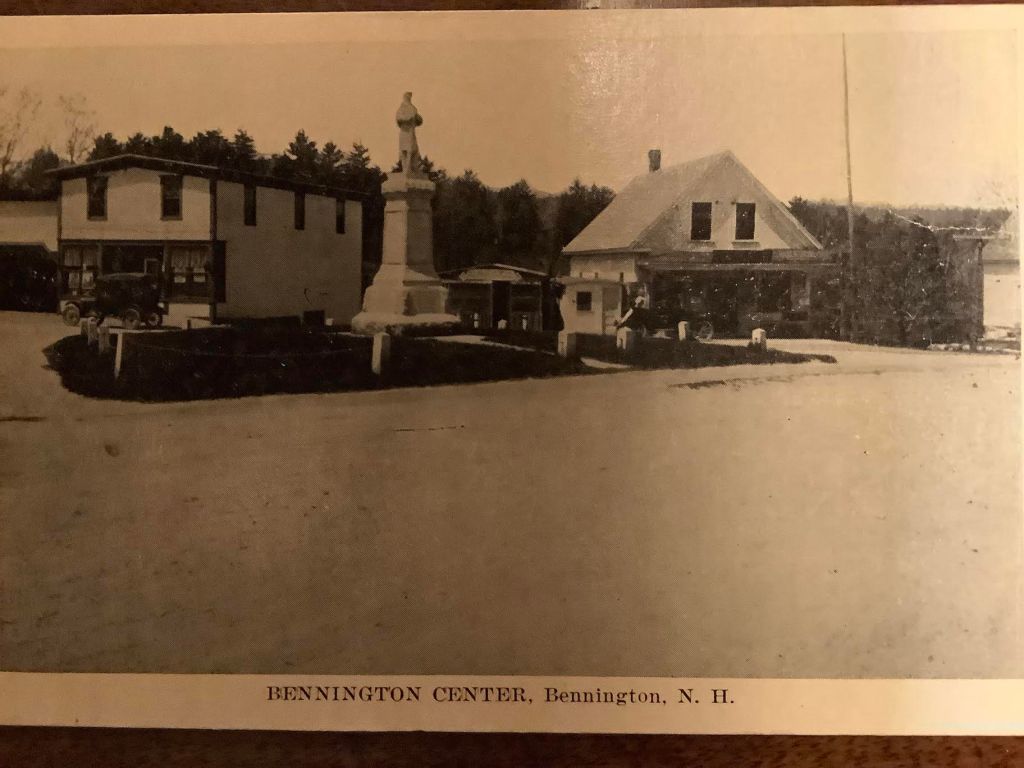
Bennington began as settlements along the Contoocook River, next to the Great Falls. As the town grew, the center of the village became the intersection of two State-owned roads: 2nd New Hampshire Turnpike, [aka: Route 31] linking the town to Greenfield and Hillsboro; Route 47, linking the town to Francestown; and Hancock Road, heading South then West to Hancock on Route 137. Also: Mill Road/Antrim Road, past the Paper Mill toward Antrim; and Old Greenfield Road, going South out of town toward Greenfield and Peterborough. In other words, Bennington was a major cross-roads — odd, especially when you think that the population was less than 700 people!
What did it look like then? The post card photo above shows a view looking North West at the center of the Village in the late 1930s. In the middle, is the Civil War Monument, erected in 1903 on a triangle of grass where most roads met. The street in the foreground, running lower left to middle right, is Main Street. The building seen at the left rear is Edmund’s Store, which originated as a ‘dry goods’ business in Bennington in 1936, before removing to Antrim. The building on the right rear was a pool hall and the very small building between them housed both an ice cream/candy store and a barber shop.
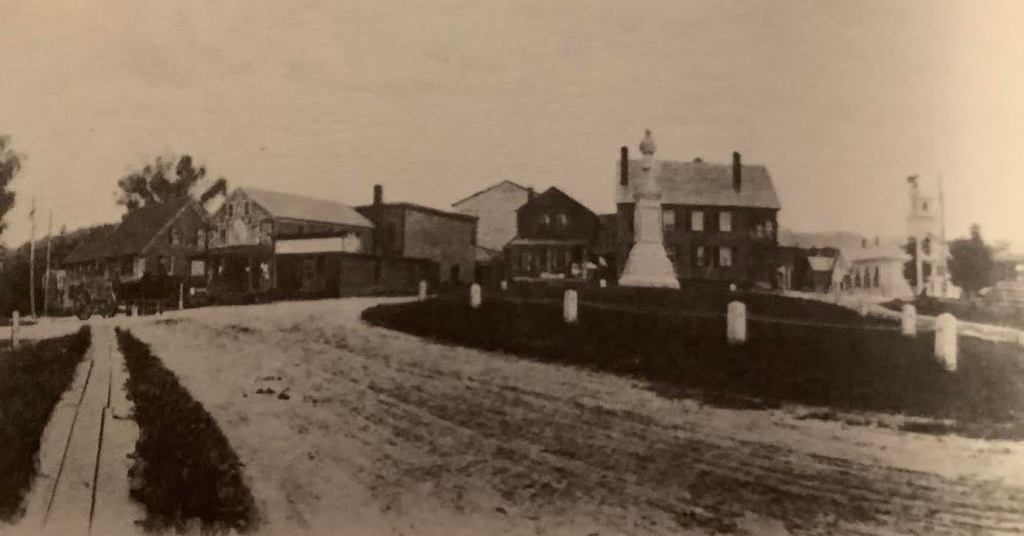
Looking North East at the center of Bennington, circa 1905.
In this view of the town center, we can see the wooden sidewalk on the left, running North. Just behind the horse and wagon at the end of the sidewalk, we see the Crystal Spring House. To the right of it is Joslin’s Store, with its colorful facade. The large house with two chimneys behind the Civil War Monument is the Adams Hotel, and the white building in the upper right is the Congregational Church.
A map from 1892, shows Main Street running North-South, crossed at #17 by Route 47 on the East, and Hancock Road going to the West, then turning South once it crosses the river. At that time, there was no Route 202.
The next installment will be posted on April 17. If you click the Follow button, all future posts will be sent straight to your inbox every month.
Hancock was founded in 1779, Francestown in 1772. Then there’s Antrim in 1777. So how come Bennington didn’t become a town until 1842?
Come back in time with me to the early 1600s, and I’ll tell you the story… As you read, count up how many different names the place now known as ‘Bennington’ has had in the past.
John Mason, of England, was very interested in the New World. In 1620, King James I drew lines on a map of North America and gave a large chunk to Captain Mason. This property ran from Cape Ann, Massachusetts to the Merrimack River. He named it “Mariana.” By the time of his death in 1635, Mason had a claim to extensive lands in New Hampshire, from the ocean to the sources of the Piscataqua and Merrimack Rivers.
For the next hundred years, his claim was fought over in endless title disagreements until a group who called themselves the Masonian Proprietors bought a clear title from Captain Mason’s son, John Tufton Mason, in 1746. Much of the land in southern New Hampshire had been divided into towns by then, except for an area on both sides of the Contoocook River. They called that region “Company Land” or “Society Land.”
These men were land speculators: they bought up land so they could sell it for a profit. Already 35 towns had been formed from Mason’s original land. As they poured over the maps, the Proprietors saw that one area was still unsettled. It was on the river, and that was a plus, but the land was rugged. Being dominated by a tall mountain, the parcel was not great for farming.
The Proprietors divided this remaining land among themselves, into fifteen plots which ranged from 500 acres to 1000 acres. By the 1770s, European settlers felt that it was safe enough to move into this area. Francestown was established in 1772, and named after colonial Governor Wentworth’s wife Frances. Deering, named for Frances Wentworth’s middle name, came next in 1774. As the Revolution seethed, Scots-Irish residents in Society Land formed Antrim in 1777.
The rushing, tumbling falls of the Contoocook River presented a problem to settlement which no one could bridge. When Hancock was granted the rights of a town, its border was the River. Land east of the River was yet unsettled. As the 1800s dawned, the only remaining part of Society Land which was not a town was a small area between Crotched Mountain, Francestown, and the River. This had been called “Great Lot Number Nine” when the land was divided among the owners of Society Land.
The first European settler in our town was Joseph Putnam who arrived in the Fall of 1782. His family had founded Wilton and Lyndeboro, and now Joseph was looking for a site for a water-powered saw mill to provide lumber to the new population. He bought the title to the land from his brother who had been the first European to visit the Falls. Soon, he built a house where Pierce School is now, having a farm, a dam, a saw mill, and a grist mill. He bought more land and the water rights to the river, and most importantly, he built a wooden footbridge to the Hancock side of the river. Before 1800, 12 or more other families settled in what was known as Putnam’s Mills. These families included Colby, Dodge, Huntington, Parker, Wilson, and Eaton, to drop a few familiar names.
The population waxed and waned but never really grew much due to Putnam’s exclusive property rights. Although there were no more than 30 families, they elected selectmen, appointed constables, and held town meetings at Putnam’s house. From 1785 on, petitions were made to the State Legislature to incorporate or to join neighboring towns. Putnam and his land joined Hancock prior to his leaving the area. This created problems for the remaining residents: no local church, no town hall, no local school, no local post office, no businesses except family farms.
But after Putnam left, new mills and industries grew up along the river, run by the Whittemores and the Burtts. This attracted a greater population to work in the cotton mills, the saw mills, the hotel, the woolen mill, the fulling mill. The area, still part of Hancock, was then called Hancock Factory Village. Home industries included paper making and gunpowder manufacturing. The first church was built in 1826, and the town had a building boom in the 1830s. New roads and new bridges lead new people into the not-yet-a-town.
In 1842, after simmering disputes with Hancock over school, liquor laws, and feeling like second-class citizens, John Huntington asked the State Legislature for an independent town of their own. Hancock voted against this at their next Town Meeting, but that did not stop the rising tide of secession. To make the town boundaries large enough to qualify as a town, parts of Antrim, Francestown, Deering, Greenfield, and Hancock were shaved off. At last, on December 15, 1842, Bennington was incorporated as the newest town in New Hampshire.
Why was it called “Bennington”? Was it after Governor John Benning Wentworth who died in 1770? Was it in honor of the Battle of Bennington [Vermont] in 1777? Was it named by US President Franklin Pierce after the road where his friend was killed in a duel? Oddly, no one seems to know, although the connection with the Wentworth family seems likely. Yet why would people who so recently won their independence want to be linked to a colonial governor? We may never be sure why the name was chosen, but Bennington we have been since 1842, and Bennington we will remain.
This is the blog of the Bennington Historical Society in Bennington, NH.
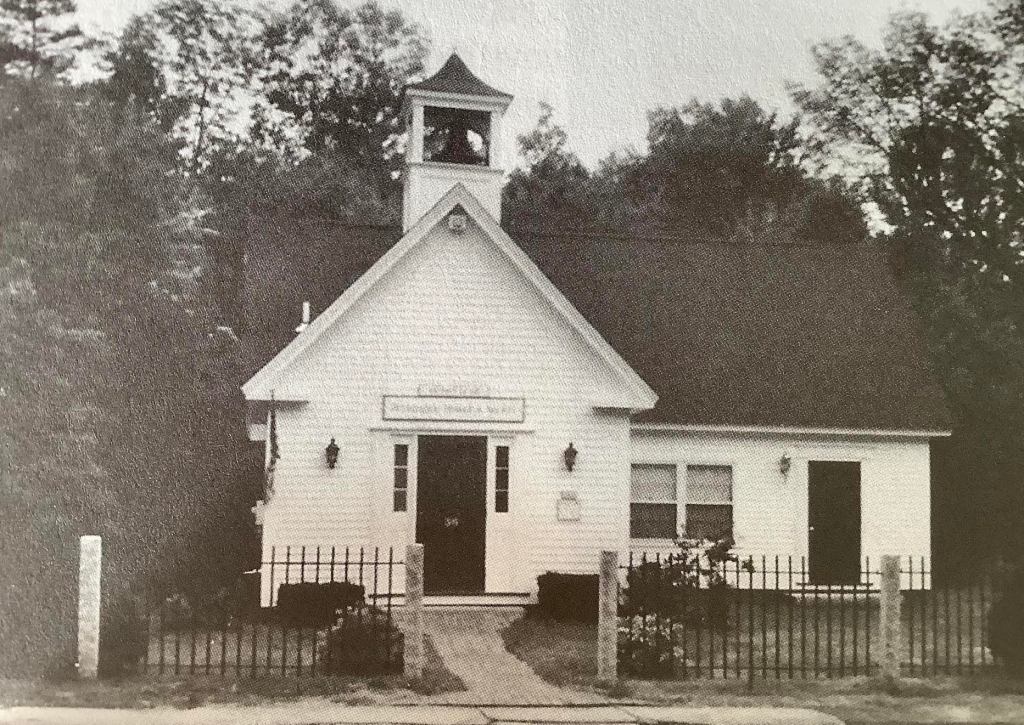
Welcome to the Blog of the Bennington, New Hampshire Historical Society. Our aim is to preserve and promote the history of Bennington, incorporated in 1842. Our history goes back further than that, to the First Nations people who’s village was along the banks of the Contoocook River 9,000 years ago and the Europeans who moved into the area in the late 1700s. Since then, much has occurred around the Great Falls of the Contoocook, and the Historical Society will tell you about it in this blog. The purpose of this blog is to take the history to the people, wherever you are. Should you find yourself in the area, visit the Historical Society, pictured above, located at 38 Main Street, Bennington, NH. From May to October, the museum is open from 10 am to 1 pm. If you have any inquiries, you may phone 603-588-4871.
The Bennington Historical Society was established in 1984 to collect and preserve antiques and literature that pertain to the history of Bennington, NH. As the collections grew, the Society needed a home for these historical items. The Town gave the Society a building that was originally built in 1852 as a ‘pest house’ for the Town of Bennington to isolate those who were suffering from the small pox pestilence. The building was later used as a ‘tramp’ house, jail house, and then storage for the fire station. After lots of fund raising, community suppers, raffles, and auctions, the Society was able to purchase a plot of land from Monadnock Paper Mill. In July 1992, Ron McClure and Donald Glynn organized the move of the building to the former Woods-Kimball Cutlery Shop site at 38 Main Street. Restoration started immediately. This was the beginning of a new landmark for the Society and the Town of Bennington.
Since this time, the Society has added the belfry and bell, and two additional museum rooms were added thanks to the generosity of Pearl Walker. Her gifts made the additions possible, reflecting her fondness for Bennington.
Following years of research and planning, in 2010, the Historical Society celebrated Bennington’s downtown district as being listed on the State and National Register of Historic places in New Hampshire. The three-year project included cataloging and describing 137 historic buildings, sites, and structures in the downtown village district. These histories will be digitized in national records and will be histories that will never be lost.
The Society continues to accept donations of historical significance for the enjoyment of future generations. We are also accepting new members. Please call the museum if you have any historical artifacts would like to donate or if you would like to join the Historical Society.
 Bennington, New Hampshire HistorySite Title