One can tell a lot about the economic history of a community by looking at the houses. If one style predominates, that reveals when the fortunes of the town were at their peak. Architecture styles change over time, showing the preferences of the people based on convenience, availability of materials, and outside influences. Bennington is no different, as eight distinct styles were employed from late 1700s to the 1950s: the Cape; the Colonial; the Federal; the Gable-Front; Gothic Revival; Italianate; attached barn; Second Empire; Queen Anne; and the Ranch.
In the old days, people built houses with one of two orientations: front door/long axis facing the road, or front door facing South, to maximize sunlight and winter warmth. From around 1830, a major change in orientation occurred, resulting in the Gable-Front House.
Two factors went into this shift: lot size and the Greek Revival. As town populations grew, previously large lots were divided. Some of the resulting lots were too narrow to build a Cape or Federal, so the house was rotated 90 degrees, causing its gable end to face the front. The style quickly became popular in urban areas. Furthermore, early in the 1800s, with the discovery of Pompeii, interest about Classical architecture grew. Houses with the gable facing the road became the next new thing — very fashionable.
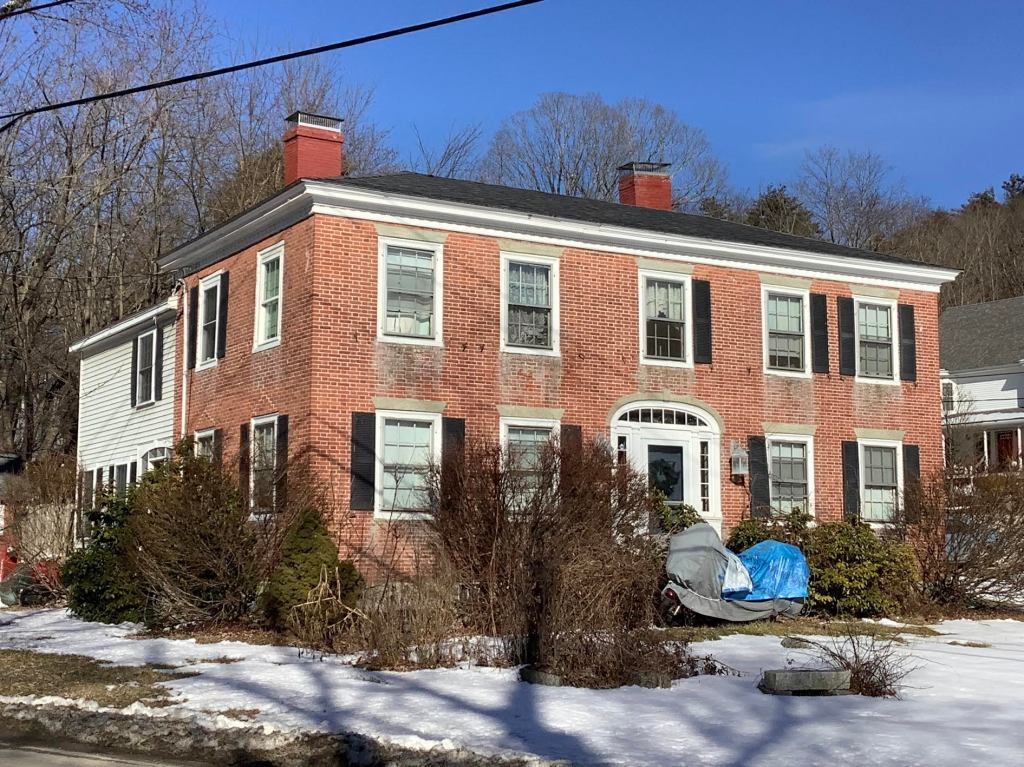
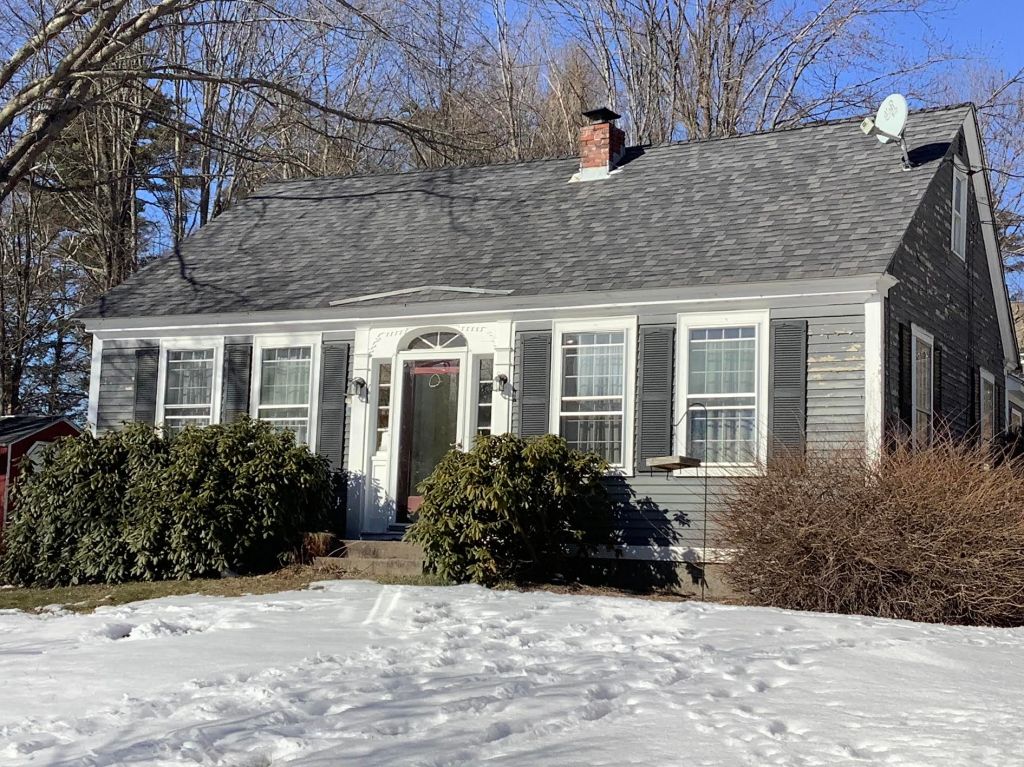
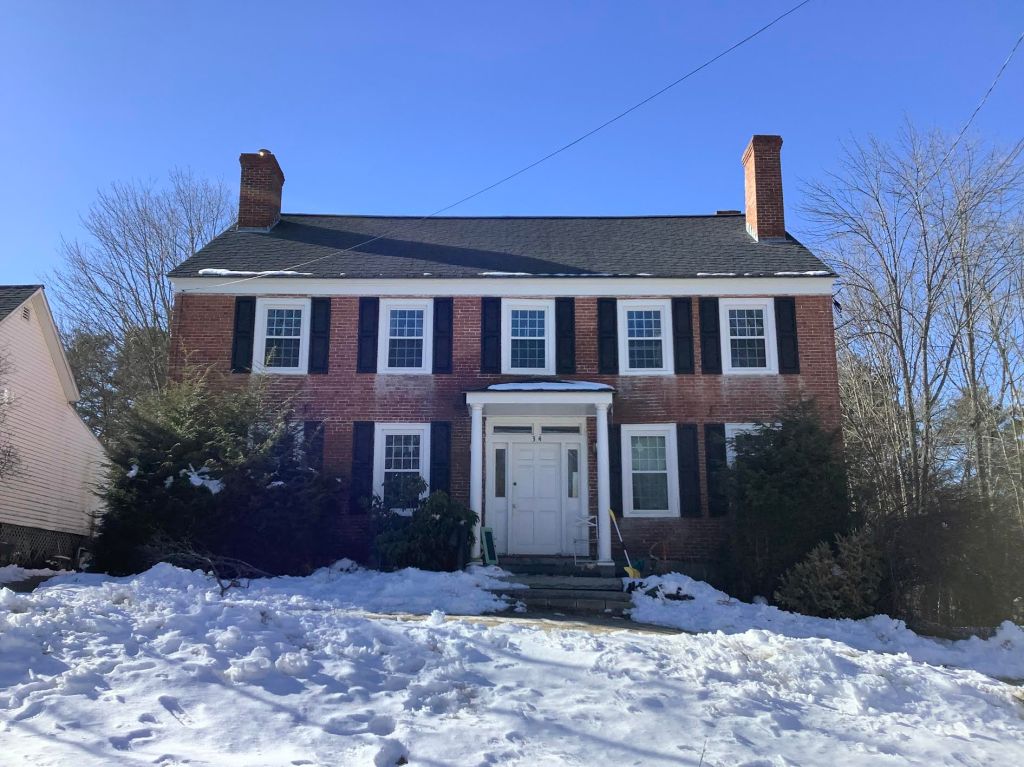
Going away from the Village on Bible Hill Road, we see Gable-Fronts.Also on Bible Hill Road, another example, with a bit less symmetry.
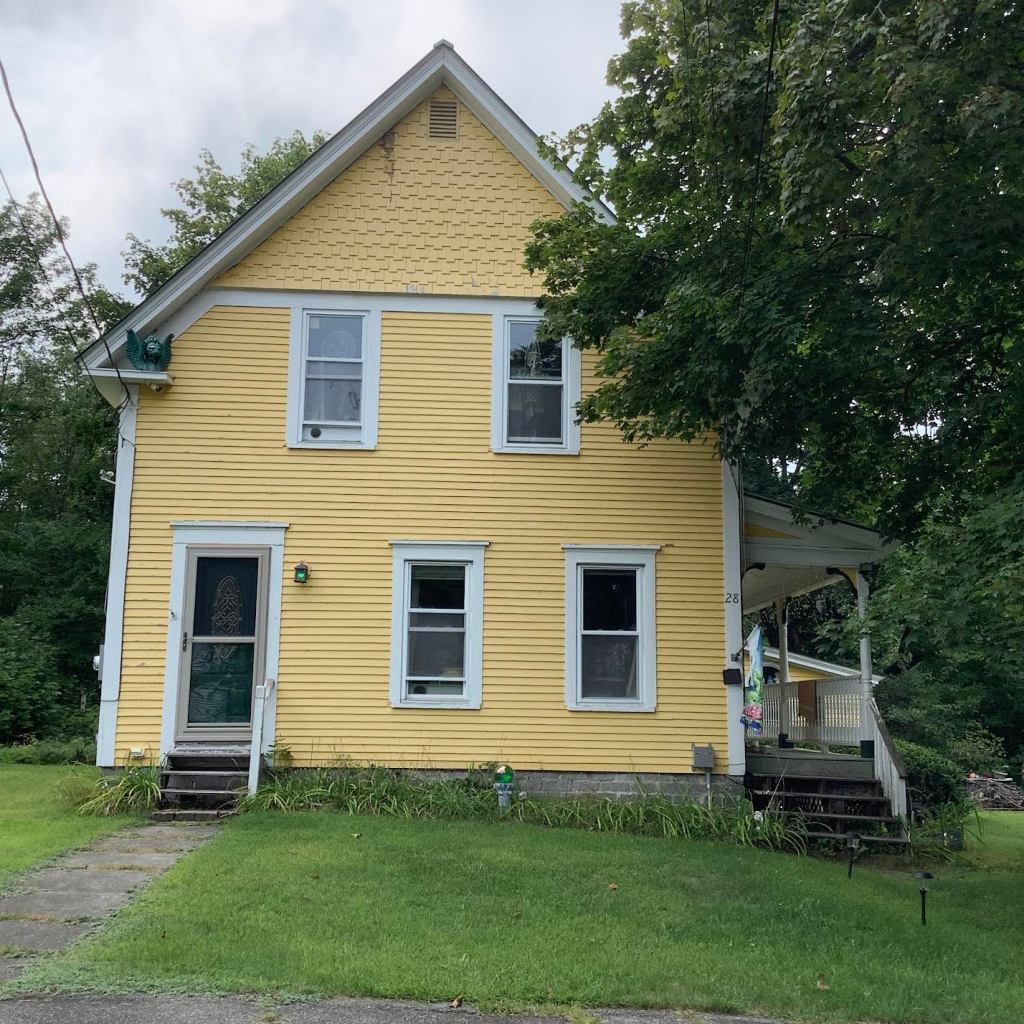
Typically, the house had 2.5 stories and was one or two rooms deep. The front door was on the left or the right, along with two windows downstairs and three windows upstairs. The gable roof line is strongly reminiscent of the pediment on a Greek temple.
This Acre Street version has only two windows upstairs.This Acre Street version adds a front porch.
The style was popular throughout the 1800s and into the early 1900s, since it could be constructed as a large, stately house or as a smaller, humble dwelling. It was often the base style for subsequent add-ons in the later part of the century, as we shall see in a future post.
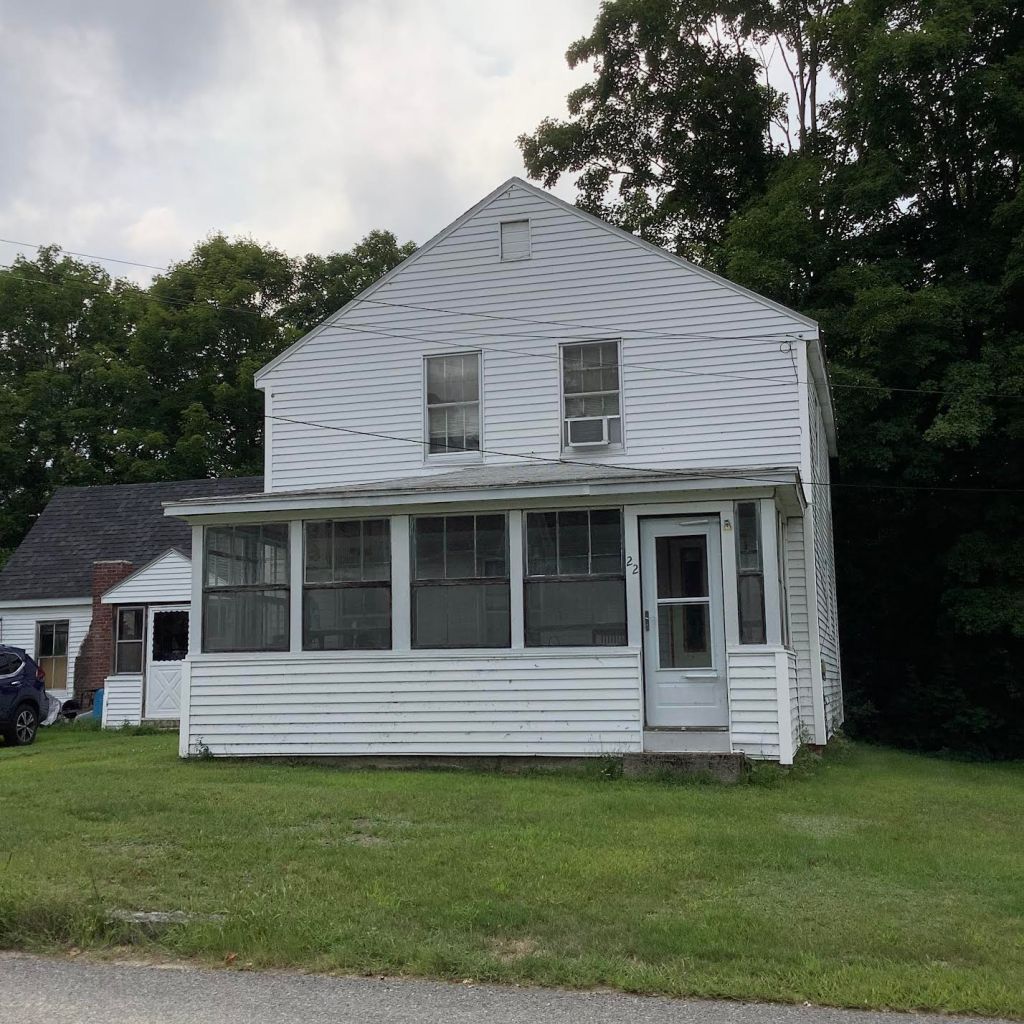
A stately house on Mill Street has a Gable-Front.A Worker’s House on Starret Road has a Gable-Front
The next installment of the Bennington NH Historical Society Blog will be posted on September 16, 2024. If you click the Subscribe button, all future posts will be sent straight to your inbox every month – for free.
Before there was a ‘Bennington’, back when it was called “Society Land“, there were schools here. In 1791, citizens agreed to hold a school at John Putnam’s house, but after 1794, classes were held at Horace Roger’s house. These might have been “Dame Schools”, where a mother or grandmother or maiden aunt would undertake the education of the neighborhood children in her sitting room.
By 1797, so many families were setting up homesteads far beyond the river-side village, that the town established three ‘school districts’. Each District served 8 households, but that did not mean that each school had the same number of students. The Southern District was near the Greenfield border, on the Greenfield Road, serving the Rogers, George, Eaton, and Martin families. The Middle District covered the homesteads east of Town on the Francistown Road, for the Dodges, Newtons, Bells, and Favors. The Northern District school was at the lower end of Gillis Hill Road in the orchard/ pasture of the Colby Family. Children from the Sweetser, Burtt, Colby, and Huntington families might have walked a mile or less to attend. Built without a foundation, the school-house was small but it had a wood stove and its own near-by well.
Rough locations of the three school districts established in 1797, shown on a map from 1858.
The schools were paid for by taxes, with money being allocated to each school based on the number of students. School was in session for two terms: Fall and Spring. In 1798, a Summer term was added, but school attendance was never mandatory. Sometimes parents were not happy with the education for which their taxes paid. In 1799, families west of the river on the Hancock border lobbied to have their children attend Hancock’s school. Some things never change.
The next installment of the Bennington NH Historical Society Blog will be posted on August 19, 2024. If you click the Subscribe button, all future posts will be sent straight to your inbox every month – for free.
In 2013, neighbors Janice and Molly decided to start a rhubarb celebration. Why? you might ask. They were looking for a fund-raising activity to benefit the town library’s building fund, and they thought that it was high time that there was a town fest of some sort. Rhubarb is the ‘first fruit of the season’ and by early June, the plant is up and thriving in gardens all over the region. No other town in the area had a Rhubarb Festival, so it had to be Rhubarb! After much planning, they held a bake sale on the Library Lawn in early June. The next year, a baking contest, a face-painter, craft sellers, a children’s Fun Run, and a basket raffle joined the bake sale.
More events were added to the festivities, so activities moved from the down-town Library lawn to Sawyer Memorial Park. By 2020, the Town’s Recreation Committee was involved in the planning. There was no Festival that year at all due to the Pandemic but through modern technology, entries for widest leaf, longest stalk, and rhubarb floral arrangements were judged on-line.
This year, the Festival will be held on Saturday, June 1, 2024 at Sawyer Memorial Park from 10 am to 4 pm, and the Library Trustees are in charge. Parking and entrance are free. There will be craft vendors and food vendors; children’s activities and contests for adults and children. The Library Bake & Book tent is always popular — that’s where the Rhubarb Pies are for sale! Proceeds still go to the Building Fund.
All in all, Bennington has embraced its home-grown Rhubarb Festival, just as the early settlers welcomed the first fresh vegetable of spring when the Rhubarb came up every year. We hope that the Festival will continue for decades to come. Rhubarb has been called the “neighbor plant” because when you started your homestead, neighbors would give you rhubarb to plant. It would be right neighborly if you would come to our Rhubarb Festival.
The next installment of the Bennington NH Historical Society Blog will be posted on June 24, 2024. If you click the Subscribe button, all future posts will be sent straight to your inbox every month – for free.
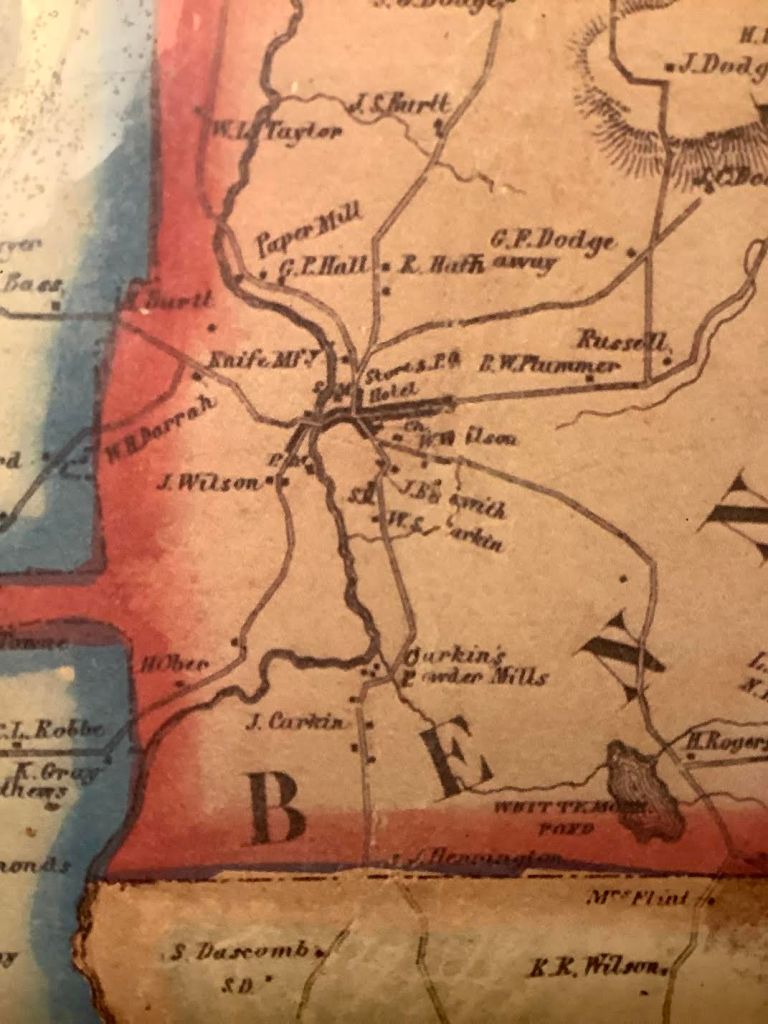
On this 1858 map of Bennington, we see the house of ‘J. Carkin’ [just above the B] and ‘Carkin’s Powder Mills’ [just above the E]. Note that there is no Powder Mill Pond at this time.
Bennington became a community because of its factories. Most began as ‘cottage industries’ and one of the oldest was John Carkin’s gunpowder mill. Carkin was originally from Lyndeborough, but moved to the banks of the Contoocook in 1823, when he was 31 years old. Initially, his house was on the Greenfield side of the river, and that was where he made his gun-powder — at home. We do not know where Carkin learned his trade, but he was rather successful at it.
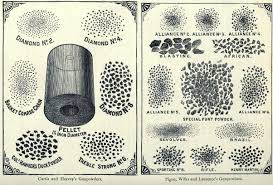
The making of gunpowder involved several steps. First, you needed charcoal, made from the controlled burning of hardwood trees. The charcoal was crushed, then combined with sulphur and saltpeter. The mixture had to be kept moist, otherwise it might explode. It was rolled into cakes and then permitted to dry. The dried cakes were pulverized and sifted into sizes suitable for various guns: from hunting rifles to cannons.
To move this dangerous manufacture out of his house, Carkin dammed the Contoocook River south of the town, creating the Powder Mill Dam. When Bennington was incorporated, the section of Greenfield that contained the powder mill became part of the new town. By 1850, Carkin’s business was thriving, employing him and his son Willard, also Thomas West and Lucas Griswold, all described a “powder manufacturers” . The mill contained crushing rollers which were powered by the river, but that made the job no less dangerous. Some workers were killed by fires or explosions — such as Carkin’s brother Aaron — or killed by the machines themselves. The only reason to work there was the exceptionally high pay and the extremely short hours. I have been told that the company provided gunpowder for Union troops in the Civil War.
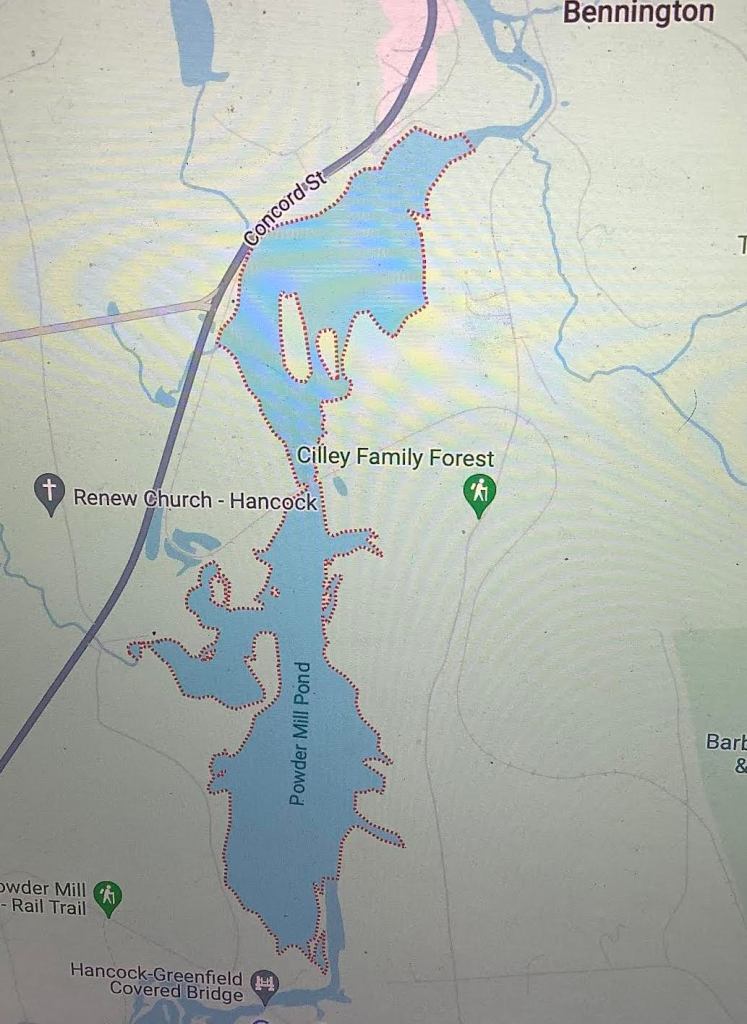
In 1866, Willard Carkin sold the mill, the dam, and the land to George W. Burns, who continued to operate the mill. Willard still worked there. His father died at age 91 in 1883, and the mill closed a few years later. Nothing remains of Carkin’s mill or his house. Perhaps they are under the water of the Powder Mill Pond, formed by expanding the dam in the early 1900s.
The next installment of the Bennington NH Historical Society Blog will be posted on May 27, 2024. If you click the Subscribe button, all future posts will be sent straight to your inbox every month – for free.
In small towns of northern New England, if you see a Roman Catholic church, you know that you are in a former or current Mill Town. With the influx of people from Quebec Province, Ireland, and Italy in the 1890s, those workers needed a place of worship. And so it was in Bennington, New Hampshire.
The oldest churches in Town were the Congregational Church [1833] and the Baptist Church [1824]. The Town was founded as a place for mills, but originally those were small, local, family-run operations. Immigration to Bennington hit its stride in the late 1800s, when people arrived to work in the Paper Mill. These immigrants needed a church of their own, but there was no Catholic Church.
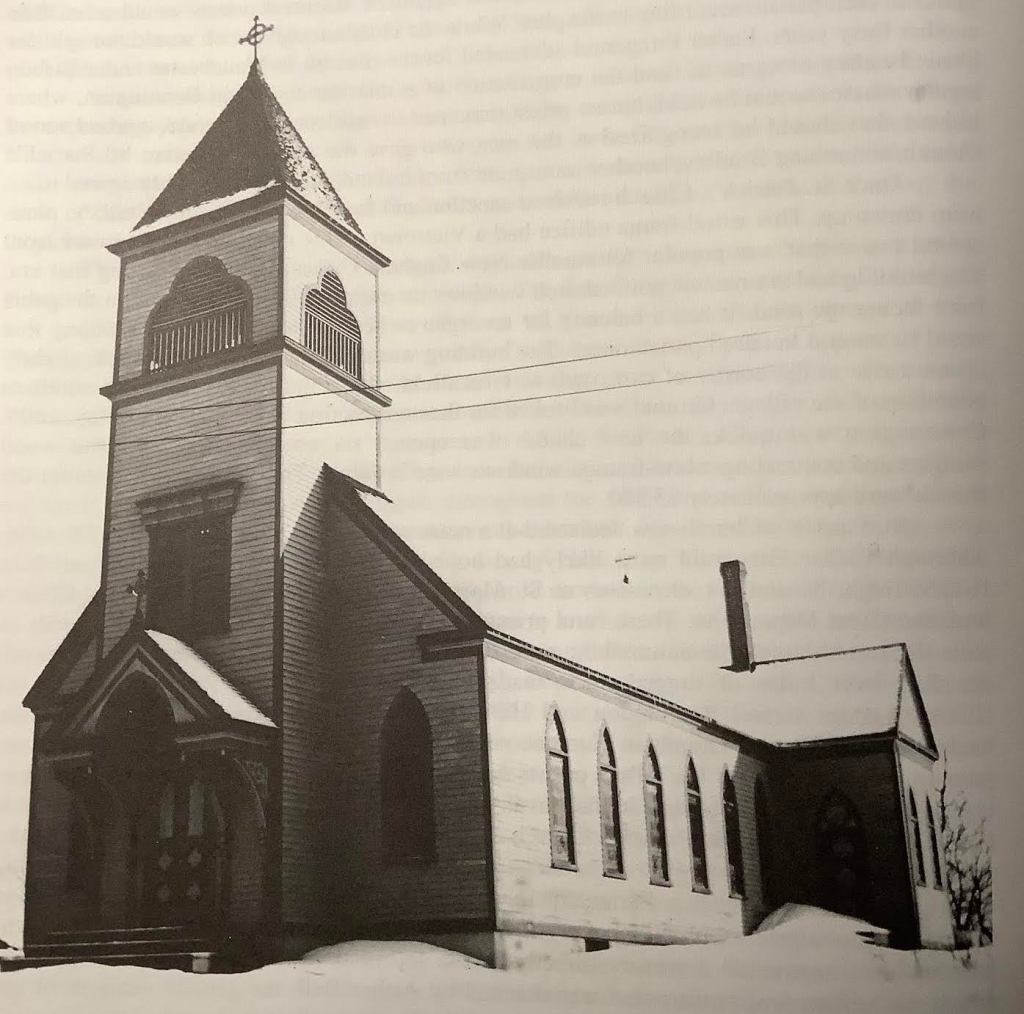
The first Catholic residents of the Town had to travel to Keene to attend church. Beginning in 1870, a priest from Keene would come to Bennington once a month, to hold mass in some private home. In 1875, they could go to Peterborough, once a church was established there. In the 1880s, Catholic church services were held weekly in the Town Hall, conducted by visiting priests from Hillsboro. It was a dream to have a church of their own and a dedicated cemetery. All this required several steps: purchasing land [1894], receiving permission from the Bishop for a ‘mission church’ without a resident priest [1895], and building a church. Ground was broken in 1895, for a church named Saint Patrick’s which rose on a knoll at the south end of Main Street, where it turns south to Greenfield.
The original church, before it was painted white.
Not until 1936 did the parish finally have its own pastor for the flock. A house was built across Greenfield Road from the church as a rectory and parish hall. By 1942, members of the parish came from Greenfield, Antrim, Francestown, Hancock, and New Boston. In 2005, the Bishop of New Hampshire decided that there weren’t enough priests to go around. Thus the Bennington, Harrisville, and Peterborough parishes were to be com-bined into Divine Mercy parish. In 2011, the church was decommissioned, and for a few years the basement of the building was the location for Town elections, until they moved to the school due to mold in the walls. The building is now a private home.
The next installment of the Bennington NH Historical Society Blog will be posted on April 29, 2024. If you click the Subscribe button, all future posts will be sent straight to your inbox every month – for free.
One can tell a lot about the economic history of a community by looking at the houses. If one style predominates, that reveals when the fortunes of the town were at their peak. Architecture styles change over time, showing the preferences of the people based on convenience, availability of materials, and outside influences. Bennington is no different, as eight distinct styles were employed from late 1700s to the 1950s: the Cape; the Colonial; the Federal; the Gable-Front; American Gothic; Italianate; Second Empire; the Queen Anne; and the Ranch.
High up on Verney Farm Road, we find this gem of a Federal-style house. Only one room deep, it has extensive additions in wood, built as the family out-grew the original farmhouse.
The ‘Federal Period’ of US history coincides with the years after the Revolutionary War. Our nation was then deciding what type of government to use, and eventually, it was agreed that a Federal System would work best. From about 1780 to 1840, a style of architecture emerged called “Federal.” An evolution of ”Georgian Style“, it is very similar. What makes a house of this era Federal instead of Georgian is that it is built in America — Georgian Style is named after the British king against whom we rebelled. No way was anyone going to name a house style after him any more!
Benjamin Whittemore built his elegant Federal in 1830 at the North end of Main Street. The bricks were produced in Bennington with clay from the Weston family property. Note the wooden El at the back, which most likely housed the kitchen.
There were two stories, like a Colonial, five windows above, two windows flanking the central door. Often built of brick, these buildings had two or four chimneys and were highly symmetrical. One of the hallmark features surrounds the doorway: above the door is a ‘fan’ of wooden slats or often a fan-shaped window. Alongside of the door, on both sides, are small-paned, narrow windows. You see that fan-light, you are seeing a Federal.
Stagecoach Road is the site of another grand Federal house that checks all the style boxes.
Inside of the rectangular or square building were rooms at each corner: four upstairs, four downstairs. There was a large central hall that featured a graceful staircase to the upstairs. Often, a two-story wooden El was built on the back, for more bedrooms and for work space for the servants. The roof is gable-ended or hip-style.
When the Federal Style was popular, owners of older houses would ‘up-date’ their Capes or Colonials by adding windows around the front door to look more modern. That sure muddies the waters when trying to guess the age of an old house!
This Cape-style house on Bible Hill Road has a very Federal doorway.This house on Main Street has elements of a Colonial, with a Federal-ish doorway and portico.
The next installment of the Bennington NH Historical Society Blog will be posted on March 25, 2024. If you click the ‘Subscribe’ button, all future posts will be sent straight to your inbox every month.
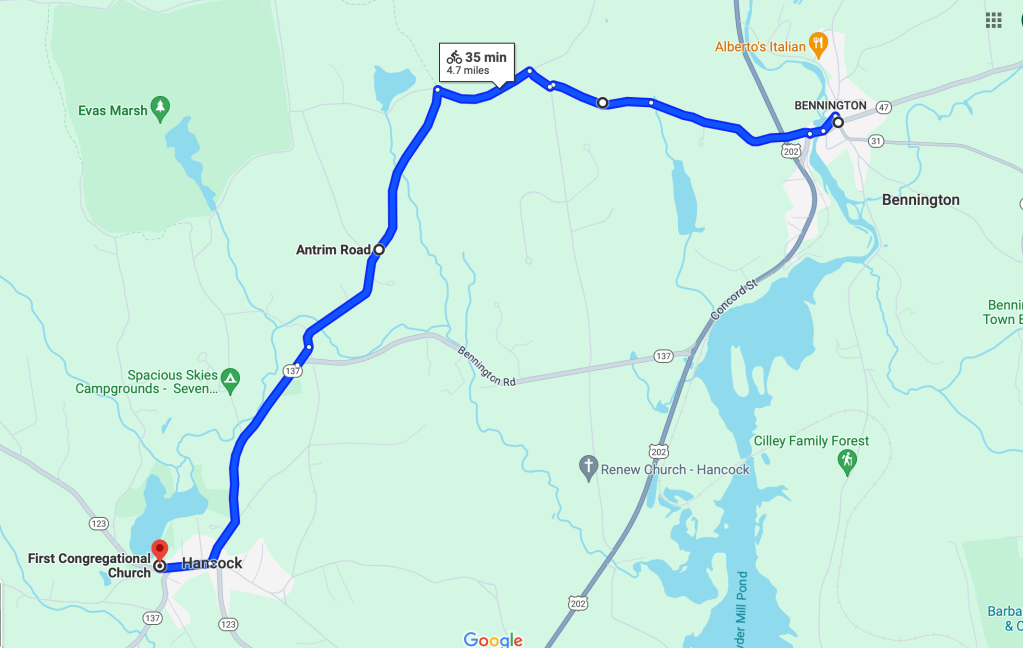
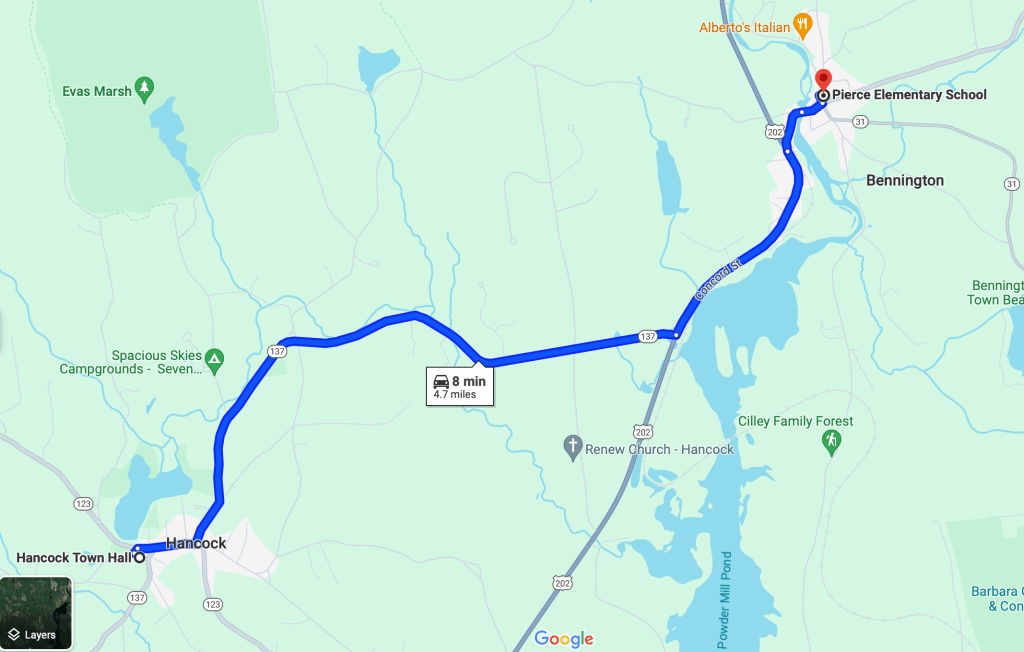
One of the most important roads in early Bennington was the road to Hancock. Until 1842, Bennington was part of Hancock, so if you had to go “to town,” that was the town you were going to. Nowadays, it takes eight minutes to drive the 4.7 miles, but in 1820, you would have gone by horse or wagon or on foot — and it would have taken a lot longer. Remember, that there was no US Route 202 in those days, so there were two ways to go, both over back roads. The Google Map screen shots below show both the approximate routes. Hancock Road was the better route, since it did not involve climbing steep Pierce Hill, but it tended to be much muddier when wet due to proximity to the river.
One path to take was over Pierce Hill Road to where it intersected with the road from Antrim to Hancock.The more usual route was to take Hancock Road, which went South along the River, then to Hancock.
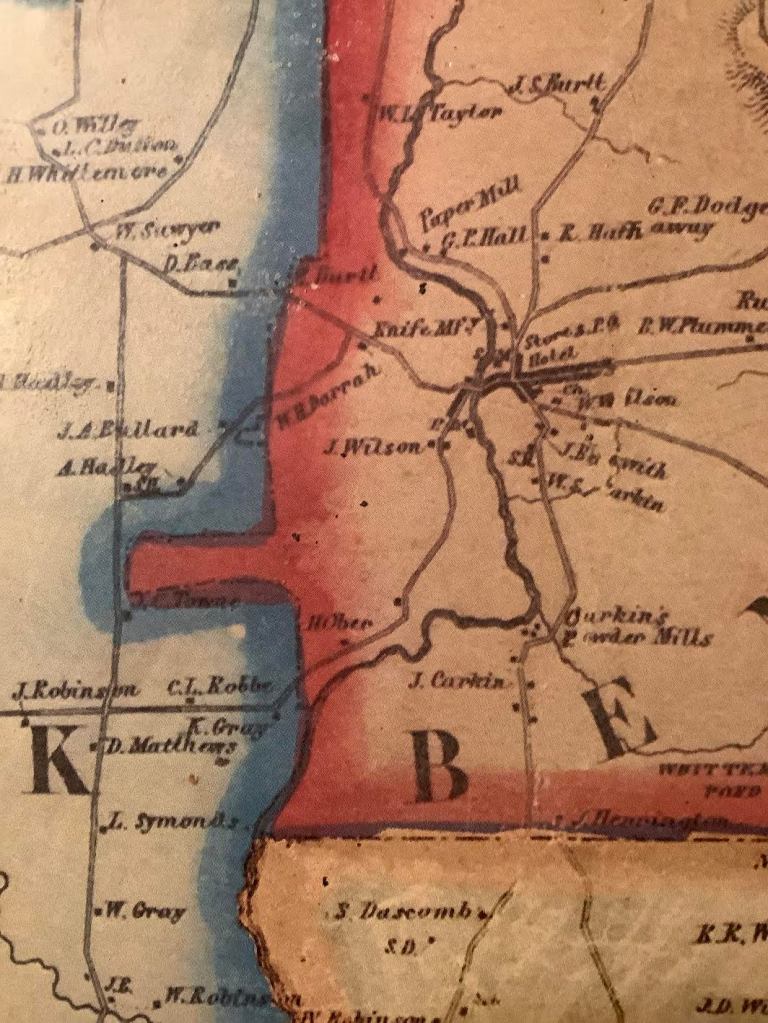
Today, “Hancock Road” in Bennington runs from the former Bennington Train Station south-west along the river to join what is now Route 202 West. The 1858 map below shows the full extent of the route, trending south-west, past the houses of J. Wilson and H. Ober, then taking a right onto what is now NH 137, which leads to the center of Hancock. It was a bucolic unpaved road, suitable for horse travel or pedestrians. In the Summer, it would be shaded but dusty. In the Winter, it would be snow-covered and drifted. In Mud Season, it would be impassable.
View of the road to Hancock, from an 1858 map.Colorized picture postcard c. 1890 with the title: Hancock and Bennington Road. Beautiful Autumn Scene.
Imagine having to travel that distance to attend church on Sunday, to go to the Town Office to pay taxes or to speak to a Select Man — it would be an all-day excursion! In a time when people were self-employed [as farmers] or were on a factory payroll, there was no time to travel the Hancock Road for a less-than-serious reason.
The next installment of the Bennington NH Historical Society Blog will be posted on February 26, 2024. If you click the Follow button, all future posts will be sent straight to your inbox every month.
Nowadays, ‘pest control’ might mean getting the red squirrels out of your attic, but in centuries past, it was a matter of public health and safety. Epidemics would sweep through communities: cholera, diphtheria, measles, chickenpox, influenza. We are vaccinated against diseases these days, but before modern medicine, they could kill. Towns needed a way to deal with pestilence, since there were no hospitals and not every town had a doctor.
Isolation was a method for stopping the spread of infectious disease. An infected family could shelter in place. But for illness in many homes at once, there was the Pest House [that’s short for ‘pestilence’]. Bennington built a simple structure on the West side of the river, outside of the Village Center. The very ill who were highly infectious would be sent there to wait it out. Volunteers, either a family member or a charitable townswoman who had previously survived the disease, would tend the sick.
The building was fair-sized but comfort was doubtful. The sick probably had to provide their own bedding and food. This was not a hospital in the modern sense — it was a holding space to keep the sick away from the well, until they recovered or died.
Eventually the building had other uses. Being near the railway, it became the Tramp House for a while. Homeless men who were out of work would ride the rails in the 1930s, going from place to place looking for jobs. When they arrived in Bennington, they were told to stay in the Tramp House until they left town.
Later, the Pest House was moved next to the Town Hall and used for storage. At last, it was moved down Main Street, to the sight of one of the original factories, to become the building for the Bennington Historical Society.
The next installment of the Bennington NH Historical Society Blog will be posted on January 29, 2024. If you click the Follow button, all future posts will be sent straight to your inbox every month.
In the 1800s, when the train tracks were laid down in New Hampshire, a town would be very glad to get a station on the line. Not to have access to a line was to go down the path to obscurity. As the century progressed, train lines were formed, and merged until much of the state was covered. The Northern Railroad Company was founded in 1844 and by 1881, track was in place to run along the Contoocook River, from Peterborough to Hillsboro. [Hillsboro used to be Hillsborough, but the railroad shortened it to fit on signage. Peterborough insisted on the longer name.]
Railroad map from 1894, showing Bennington with neighbors.
Every town along the line wanted a station — for shipping goods and especially to deliver fresh milk to creameries in the cities. Not every town was lucky enough, but Bennington won the lottery with three stations!
One was on North Bennington Road, where Tenney Farm grows corn now. Although in Bennington, this was officially the Antrim, NH station, since that was the closest that a stop could be located near the center of that town. Both passengers and freight were handled there, but perhaps its chief function was collecting milk. Farmers would come from West Deering and from across the river to get the milk to the train every morning. Some buildings along the track were still there in the 1970s, but they are gone now.
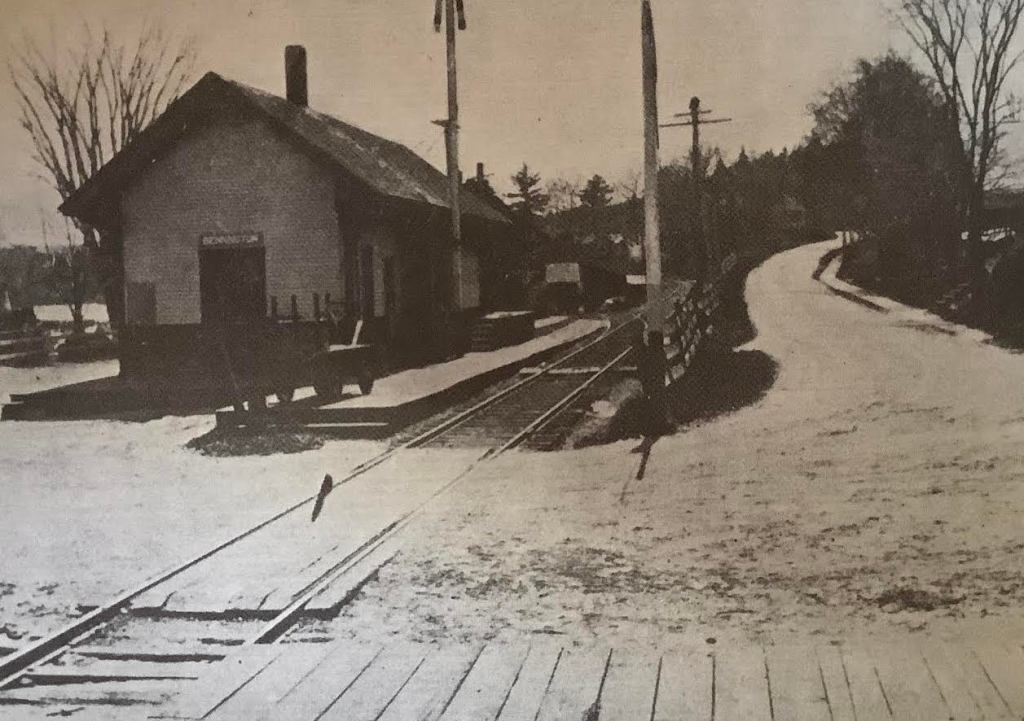
The official Bennington station was near the center of town, between the track and the River. One could get on the train there and have access to Nashua in the South, via a stop at Elmwood Junction in Hancock, or go to Concord in the North, with a stop in Hillsboro.
This is the principle train station for Bennington, at its original location between Hancock Road and the Contoocook River. Here we see it from the North around 1900.
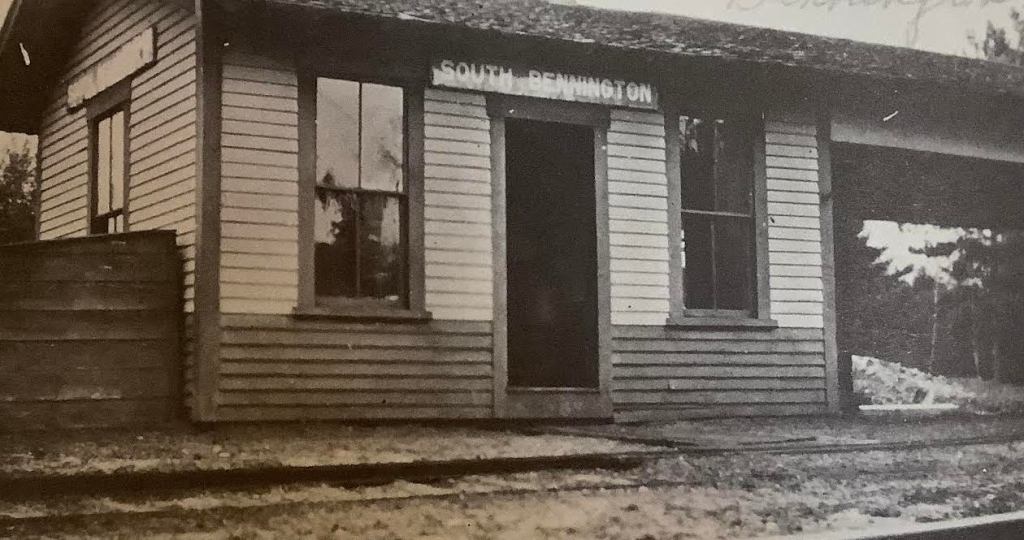
The third station was on South Bennington Road at the Greenfield town line. This little station was primarily a milk stop, and as soon as trucks began to transport milk, the station was closed. If you lived in South Bennington and you wanted to go into the Village, you could flag down the train along the line and hitch a ride. Many students from Bennington went to high school in Hillsboro because it was easier to take the train to there than it was to get to the school in Antrim. Nada Wilson Huntington was one of them, since her family lived next to the track.
South Bennington Station.
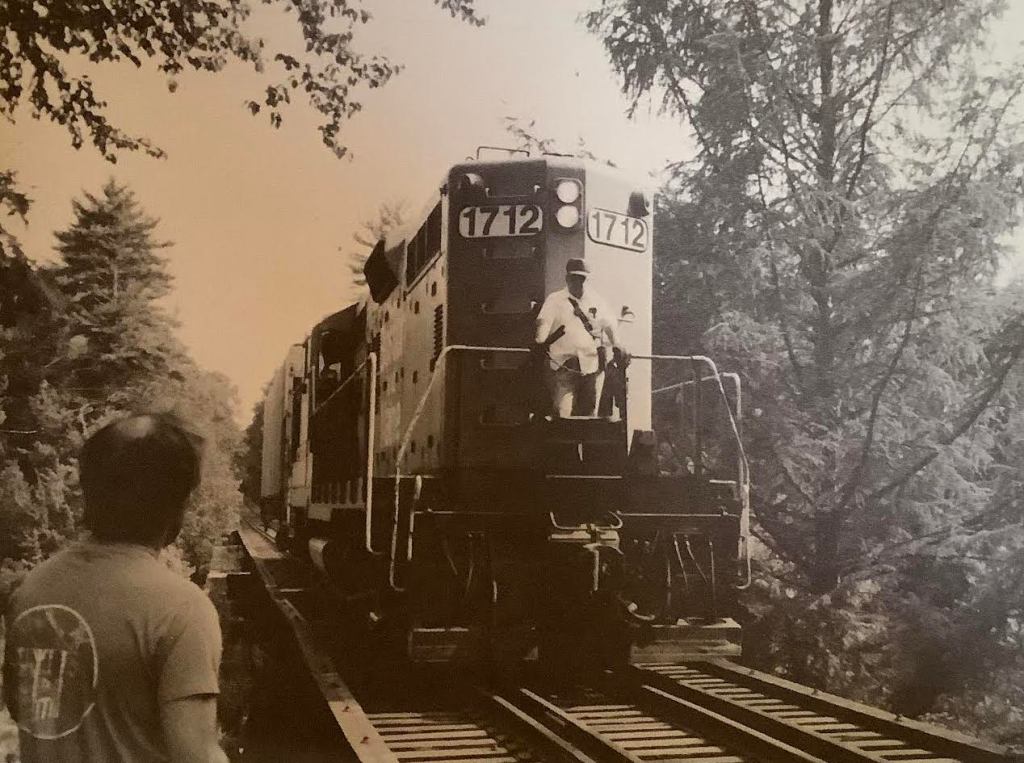
In 1906, the line running through town was the Boston and Maine Railroad, due to a merger, and so it remained until the formation of the Milford-Bennington Railroad Company in 1987. That company hauled sand and gravel to Wilton. One evening, the train stopped on the track so that the engineer and brakeman could cross Route 202 to have dinner at the Powder Mill Pond Restaurant.
On May 26, 1986, the last regularly scheduled train came through Bennington.
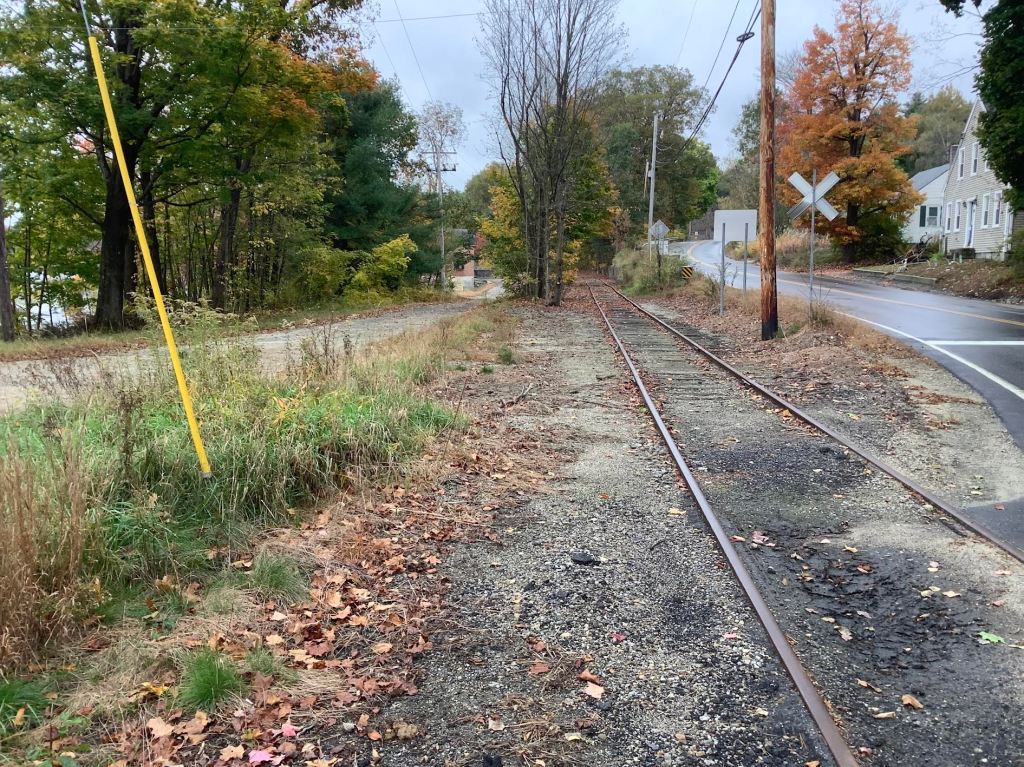
Today the main station is located across the street and a little bit North of its original location. It is currently the VFW Hall and is used as a meeting space for town groups. Most of the train tracks in Bennington were torn up and where steam engines once charged along, now walkers, cyclists, and snowmobilers roam under leafy canopies.
Where the train station used to be, looking South along the track, with Hancock Road on right.The train station in its new location, and in its new use as VFW Hall and meeting space.
The next installment of the Bennington NH Historical Society Blog will be posted on November 13, 2023. If you click the Follow button, all future posts will be sent straight to your inbox every month.
What do Lady Danbury, Beau Brummell, Johnny Walker, and Louis the 14th all have in common? They all wear a walking stick.
Louis XIV, who was proud of his shapely legs, introduced the cane to court.Lady Danbury from Bridgerton actually uses her cane.Johnnie Walker, icon of a whisky brand, wears his cane with verve.
A walking stick, as a prop for tired legs, has been around for millennia. In the Middle Ages, it was often called a ‘Pilgrim’s Staff’ since it was carried by those who trudged 100s or 1000s of miles to visit a holy shrine. But the Walking Stick as a fashion accessory perhaps came into use in the 1600s.
The French King Louis XIV was worried about assassins, so he banned the carrying of swords in court. Since gentlemen were in the habit of resting their left hand on the pommel of their swords, they now had nothing to do with their hands. A decorative staff, the length of a sword and with costly embellishments, became the substitute, and a fashion trend was born. The custom moved to England and by the early 1800s, both men and women were sporting them. The term of use was “to wear” a walking stick or cane, not “to carry” it. Indeed, these sticks were rarely touching the ground, most were too short to use as an actual cane — they were pure fashion.
The fashion continued late into the 1800s in the United States. [My great-grandfather in Pennsylvania had an ebony cane with an ivory knob.] This all lead to a brilliant marking ploy for the Boston Post newspaper. In 1909, sales needed a boost, so the publisher, Edwin A. Grozier, devised the idea of a ceremonial cane to be awarded to the eldest male resident of 700 towns in New Hampshire, Massachusetts, Rhode Island, and Connecticut. The canes were made of ebony by the J.F. Fradley company of New York. Each cane had a gold knob proclaiming it to be the gift of the Boston Post.
This Boston Post Cane is from Maynard, Massachusetts.
The canes were sent out to each town’s Board of Selectmen, who were to identify the oldest man in town and present the cane to him, with appropriate pomp. At first, this was seen as a great honor, but problems loomed. Several recipients’ families though that the cane was a gift and belonged to his survivors, despite the words “TO BE TRANSMITTED” engraved on the knob. The cane was supposed to be returned to the Select Board for reassignment, and this lead to some uncomfortable situations in many towns.
Then there was the fact that the Oldest Citizen would at some point die. So many cane holders died within months or weeks of receiving it, that the Cane was viewed as a curse. Some citizens refused to take it, leading to years with no one holding the Cane. Eventually, the Oldest Citizen was permitted to be a woman, thus the Cane could go to the actual eldest person in town.
Over the years, many of the original 700 Canes have been lost [in house fires] or stolen [watch for them in antique stores and alert the town named on the knob] or broken. There are 517 towns that still have an original Cane, Bennington, New Hampshire included. Many towns, wishing to preserve the tradition, have made replicas of their cane, keeping the original in the town’s museum and awarding the replica. Bennington’s original Boston Post Cane may be seen at the Historical Society. The Boston Post newspaper was last seen in 1957, but the Boston Post Cane lives on.
Cane Holders in Bennington: 1909-1915 Willard S. Carkin His widow did not want to give it back. 1915-1921 John Milton Bartlett 1921-1940 Thomas Wilson 1940-1944 Jerome Sawyer 1944-1948 Edward Newton 1948-1959 George Holmes 1960-1961 Minnie F. Cady, first woman in town to hold the Cane 1961-1964 Edith Lillian Lawrence 1964 J. Harvey Balch received the Cane, but turned it in when he moved to another town in an unknown year. ??-1983 Lena Tayler/Taylor was next, but she moved to Pennsylvania in 1983, so she turned in the cane. 1983-1984 Marion L. Griswold 1984-1984 Theresa Cashion Gibson, who beat out her closest age-mate, Mrs. Vivian Stimson, by being 2 days older 1984-1985 Vivian Stimson 1985-??? Margaret Sawyer, daughter-in-law of Jerome Sawyer, see above 19?? Margaret Sawyer’s brother-in-law, making three in one family! 198?-1994 Francis H. LeBlanc 2022 John Ferranti
John Ferranti shows off the Bennington, New Hampshire replica of the Boston Post Cane.
The next installment of the Bennington NH Historical Society Blog will be posted on October 23, 2023. If you click the Follow button, all future posts will be sent straight to your inbox every month.